


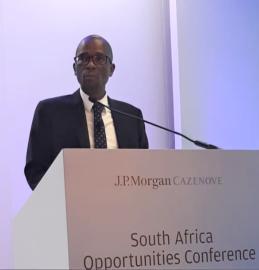
Deputy Minister of Finance, Dr David Masondo, has emphasised the importance of closing the financial inclusion gap for women and ensuring that they can leverage financial services to smooth their incomes, invest in opportunities, and protect themselves against shocks.
“Usage remains low, and significant gaps persist, particularly for women, youth, informal workers, and rural entrepreneurs,” Masondo said on Monday in Skukuza, Mpumalanga.
Addressing the second Plenary Meeting of the Global Partnership for Financial Inclusion, the Deputy Minister said empowering women is not just a matter of fairness or social equity; it is smart economics.
“When women gain access to financial tools and earnings, they invest in their families and communities to an impressive degree. Studies find that women typically reinvest up to 90% of their income back into their households, compared to around 30–40% for men.
“We have seen that financially empowering a woman creates a ripple effect; children stay in school longer, family nutrition improves, and local economies become more resilient. Conversely, when women remain on the margins of finance, we all lose out on growth and innovation.
“Let us remember that closing the financial inclusion gap for women is not a sidebar, it is central to our agenda. … Giving women access to and the ability to use affordable payments, credit, and insurance will boost development broadly,” he said.
The Deputy Minister asserted that South Africa has made women’s economic empowerment a priority in the national strategies encouraging progress is being made.
“But there is much farther to go to ensure that the creative entrepreneur I described, and millions like her can prosper. She does not want charity; she wants the playing field: levelled reliable digital payments, safe savings, and fair credit so her enterprise can grow.
“Turning this vision into reality will require concerted action on multiple fronts: public policy, private innovation, and grassroots capacity-building. South Africa is committed to doing its part.
“Through our Financial Sector Development Reform Program (FSDRP), supported by partners like the World Bank and the Swiss State Secretariat for Economic Affairs, we invest in the infrastructure and reforms that move inclusion from access to usage,” Masondo said.
The Reserve Bank has launched the Inclusive Payments Digitalisation Programme that aims to bring practical digital payment solutions to the informal sector.
“We have piloted it in two communities, Tembisa and Hammanskraal, to develop digital ecosystems right where people live and work. Some of you visited these enterprises in March.
“This pilot is a testament to what is possible when we blend policy intent with on-the-ground innovation. We plan to expand such efforts, informed by data and community feedback, so that no entrepreneur is left behind by the digital finance revolution.
“Our commitment goes further. We are streamlining regulations to encourage low-cost fintech solutions through the Intergovernmental Fintech Working Group, strengthening consumer protection to build trust in digital finance through the Conduct of Financial Institutions (COFI) Bill, and improving connectivity in rural areas through the SA Connect programme,” he said.
In essence, efforts are being made to create an environment where using financial services is easy, affordable, and safe so that inclusion translates into actual economic participation.
“But South Africa cannot do it alone. The beauty of the Global Partnership for Financial Inclusion (GPFI) is that it allows us to learn from each other and to tackle common challenges together. Every country in this room has experiences, successful policies, clever tech applications, and even instructive failures that can inform the way forward for all of us,” Masondo said.
GPFI is an inclusive platform for Group Twenty (G20) countries, non-G20 countries and relevant stakeholders for peer learning, knowledge sharing, policy advocacy and coordination.
It is the primary implementing mechanism of the G20 Financial Inclusion Action Plan (FIAP).
South Africa assumed the G20 Presidency from 1 December 2024 to 30 November 2025 under the theme: “Solidarity, Equality and Sustainability". - SAnews.gov.za


