


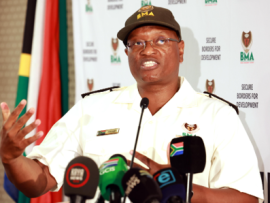
Border Management Authority (BMA) Commissioner Dr Micheal Masiapato has unveiled an expanded Festive Season Operational Plan that will see the deployment of advanced surveillance technology and strengthened regional coordination to manage the holiday travel surge.
Briefing the media in Pretoria on Sunday, Masiapato said the four-phase plan — covering planning, execution, demobilisation and sustenance — is designed to ensure smoother traveller processing and tighter border security during one of the busiest periods of the year.
He said the planning phase, which began on 15 September and concludes on 9 December, has included extensive consultations with public and private sector stakeholders.
“The planning phase is characterised by extensive consultative engagements with multiple stakeholders in the country operating in both public and private sectors. As a result, we have managed to secure few critical partnerships with various stakeholders as guided by section 5(c) of the Border Management Authority Act,” he said.
Among these new partnerships are agreements with the South African Freight Forwarders Association, the Association of Meat Importers and Exporters, and the South African Association of Ship Operators and Agents, which will help fund some BMA operations through a cost-recovery model.
Technology companies such as DCD Protected Mobility, Aselsan South Africa and Unipro Protective Wear will assist in rolling out a suite of surveillance and protective tools.
“Drones and body cams will be fully operational to improve our detection capability and also address possible corruption from our team members,” Masiapato said.
To ease congestion at key ports, the BMA has also partnered with TRAC and SANRAL to strengthen traffic flow management at the busy Lebombo port of entry.
Masiapato added that the Department of Public Works and Infrastructure will again provide temporary infrastructure — including lighting, ablution facilities, barricades and Jojo tanks — across ports and corridors.
Additional ICT technicians will be deployed to support the movement control system, with further remote assistance from the South African Revenue Service (SARS) and the Department of Home Affairs.
Masiapato said South Africa had also held discussions with neighbouring countries — Lesotho, Mozambique, Zimbabwe, Namibia, eSwatini and Botswana — to streamline cross-border operations.
“As a result, we have agreed to adjust operating hours at some of the key ports which do not operate on a 24-hour basis,” he said.
The execution phase will run from 10 December 2025 to 15 January 2026, split into a departure period (10 – 31 December) and a return period (1 – 15 January).
During this phase, enforcement measures will be tightened.
“We will be intensifying our measures to detect and seize narcotics, illicit goods, and even stolen vehicles. We want to warn all travellers to desist from committing any act of criminality around the ports or even in the border law enforcement areas as they will be detected and arrested,” Masiapato said.
Demobilisation will take place on 16 January, when ports that had extended operating hours revert to normal schedules.
The final sustenance phase begins on 17 January, with operations stabilising ahead of the 2026 Easter period. – SAnews.gov.za


