


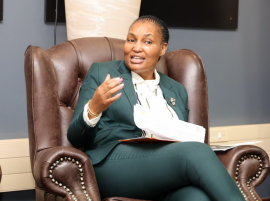
Architecture in South Africa must be about more than designing buildings but help shape a society in which people can live with dignity, access opportunity and participate fully in the social and economic life of their communities.
This was the message by Minister of Human Settlements Thembi Simelane at the South African Council for the Architectural Profession (SACAP) Education Conference.
Addressing Friday’s virtual conference under the theme: “Architecture in Changing Times”, Simelane challenged architects, educators, students and government to consider a deeper question: “not simply what kind of buildings are being designed, but what kind of society is being designed.”
For the Department of Human Settlements, she said this means confronting one of South Africa’s most enduring challenges: spatial injustice. Apartheid deliberately shaped the country’s geography, determining where people could live, work and access services.
“More than three decades into our democracy, those spatial patterns have not disappeared. We still see communities where a person's prospects are influenced profoundly by their postal code,” Simelane said.
The Minister said spatial transformation cannot be achieved by government departments or professions working in isolation, stressing that housing, schools, transport, public spaces, and economic opportunities must be planned as interconnected elements of integrated human settlements.
She highlighted the importance of viewing schools and other public facilities as community assets rather than isolated structures.
“A school must form part of a living settlement. It must connect to homes. It must connect to safe mobility routes, public spaces, [and] economic opportunity. It must connect to the broader social life of the community.”
She said shared community infrastructure can maximise the value of scarce public land, strengthen social ownership and help protect public assets.
“This requires architects to think beyond the individual building. We must ask how that building relates to the settlement around, how does it connect, who can use it, what happens there after school hours [and] what value does it create for the broader community? Architecture must increasingly help us turn public infrastructure into anchors around which stronger communities can grow,” Simelane said.
The Minister also emphasised that quality architecture is an expression of dignity, and communities that were historically denied investment must not continue receiving inferior infrastructure.
She said that a child attending school in a township, a rural community, or an informal settlement, should never receive the message that excellence, beauty and quality belong somewhere else.
“The quality of architecture communicates value,” Simelane argued, emphasising that infrastructure should send a clear message to every child that their community and future matter.
She said the construction process itself must also contribute to local development, and human settlements and public infrastructure projects should, where possible, create opportunities for local workers, artisans, small contractors and small, medium, and micro enterprises (SMMEs).
Locally appropriate construction methods and materials can help build skills, stimulate local economies and strengthen community resilience.
“Architectural education must therefore equip professionals not only with technical competence, but with a deep understanding of place, inequality, sustainability, community, and spatial justice. We need professionals who can look at a drawing and understand that behind every line is a human experience.
“The professionals we educate today will help determine whether tomorrow's South African settlement is fragmented or integrated, exclusionary or inclusive, unsustainable or resilient.”
She also called for stronger partnerships between government, universities, professional bodies, and the built-environment professions. She said integrated planning must begin “on the drawing board”, ensuring that residential development is planned alongside schools, transport, public spaces and economic opportunities.
She added that architecture has the potential to become a powerful instrument for social transformation.
“Let us use architecture not simply to construct facilities, but to reconstruct the spatial relationships of our society,” Simelane said. – SAnews.gov.za


