


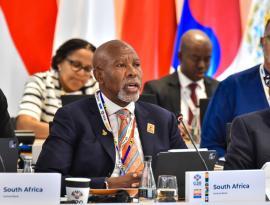
Artificial Intelligence (AI) and rapid technological advancements are changing the global economic landscape, but policymakers must ensure that this shift does not deepen inequality or leave developing nations behind.
This is according to Reserve Bank Governor Lesetja Kganyago who addressed the third G20 Finance Ministers and Central Banks Governors meeting held in Zimbali, Kwa-Zulu Natal on Thursday.
“[AI]…represents a significant turning point in the global economic landscape. Governors have just come out of a very insightful side event on the implications of AI for productivity and labour markets. What is clear is that, if harnessed effectively, AI has the potential to revive productivity growth and improve living standards.
“However, as policymakers, our challenge is not simply to catch up but to ensure that this shift does not deepen inequality or destabilise already fragile labour markets. Getting the balance right between innovation and inclusion will be one of the defining policy imperatives of our time,” he said.
The Governor noted that for emerging markets and developing economies “the stakes are especially high”
“In Africa, for instance, the working age population is expanding rapidly and according to the African Development Bank, the continent could potentially unlock up to $1 trillion in productivity gains by 2035.
But only if we close critical gaps in data, digital infrastructure, skills and capital access,” the governor said.
Kganyago emphasised that as G20 countries “we carry a unique responsibility to shape a global recovery that is not only resilient, but also inclusive and forward looking”.
“This means deepening policy coordination, advancing structural reforms, investing in economies to adapt to compete and to thrive in a rapidly evolving global landscape. It also means that ensuring that the gains of technological progress are broadly shared and to the benefit of all.
“The choices we make during these times of heightened uncertainty will shape the future of global economic cooperation.” – SAnews.gov.za


