


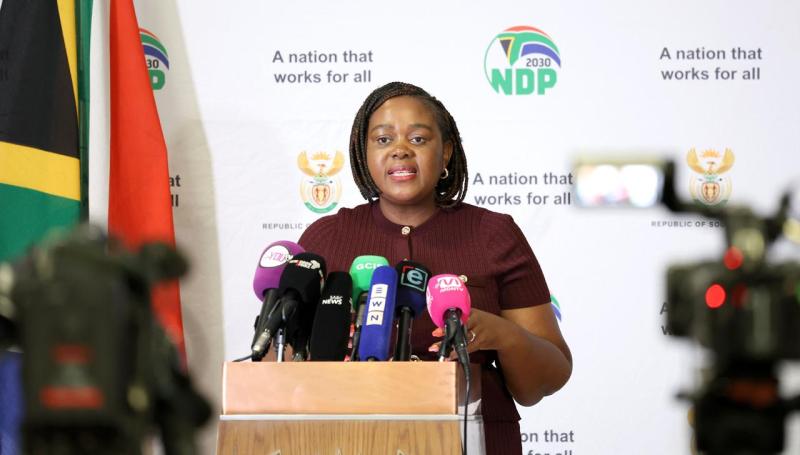
Government is moving to restore approximately 2 400 bad and hijacked buildings across South Africa’s major metros by fast-tracking court litigation, developing a national funding model for temporary emergency accommodation and establishing a uniform national reporting framework.
During an Inter-Ministerial Committee (IMC) on Migration media briefing on Thursday, committee chairperson and Minister of Justice and Constitutional Development, Mmamoloko Kubayi, set out government’s plan to tackle the challenge of derelict and overtaken buildings.
“The IMC [has] tasked the Department of Cooperative Governance (DCOG) to lead the development of a phased Program of Action for eight metros, supported by a multi-sectoral National Technical Task Team to undertake this important work.
“The Committee recognises that enforcement must be accompanied by lawful processes and appropriate arrangements for affected occupants.
“Government will not allow unsafe buildings, criminal property syndicates and regulatory failures to continue undermining the safety, dignity and stability of our communities,” Kubayi stated.
She reiterated government’s prioritisation of tackling “bad, unsafe and hijacked buildings, which present serious risks to public safety, undermine municipal governance and, in some instances, provide opportunities for criminal activities”.
Enforcing business compliance
Alongside urban renewal, Kubayi reiterated that all spaza shops and small businesses must adhere strictly to municipal by-laws, licensing rules, health standards and labour and immigration laws, regardless of the owner's nationality.
“Government remains committed to restoring compliance, fairness and accountability within the informal economy, particularly in relation to spaza shops and other small businesses,” she emphasised.
As such, coordinated interventions involving municipalities, the Department of Small Business Development, the Department of Employment and Labour and law-enforcement agencies are central to the programme of strengthening regulation of the informal economy.
The objective of the programme is to:
- Strengthen business registration and regulatory compliance.
- Prevent unlawful business practices and exploitation.
- Protect consumers and promote food safety.
- Ensure compliance with labour and immigration legislation.
- Support legitimate small enterprises and fair economic participation.
“In this regard, the Department of Small Business Development has finalised the process of recruiting 56 Business Registration Officers (BROs) for deployment across all Provinces by mid-November 2026.
“The informal economy cannot operate outside the law. Government is determined to ensure that business opportunities are pursued within a properly regulated environment that protects consumers, workers and legitimate businesses,” Kubayi said.
Strengthening cooperation
Kubayi stated that migration challenges cannot be “resolved through enforcement measures alone”.
She highlighted that for migration challenges to be resolved, cooperation is required from government, communities, business, labour, civil society, traditional leaders and international partners.
“Government continues engaging stakeholders to address concerns, promote social cohesion and strengthen understanding of immigration laws and procedures. These engagements are essential to preventing misinformation, reducing tensions and encouraging lawful participation in resolving migration-related challenges.
“Internationally, the Department of International Relations and Cooperation, working with Home Affairs and other departments, continues strengthening cooperation with countries of origin and regional partners,” Kubayi said.
Areas of cooperation include:
- Identification and documentation of foreign nationals.
- Deportation and voluntary repatriation arrangements.
- Information-sharing and border management.
- Combating transnational organised crime and human trafficking.
- Promoting safe, orderly and regular migration.
- Protecting diplomatic relations and regional stability.
Kubayi highlighted that the Southern African Development Community (SADC) has resolved to convene a multi-sectoral Regional Dialogue on Migration Governance in Southern Africa envisaged to take place early next year.
“South Africa welcomes this important regional initiative and looks forward to participating in the Dialogue, which will provide an opportunity for Member States to exchange perspectives, assess progress and strengthen cooperation on migration governance across the region.
“The Regional Dialogue is expected to assess progress in the implementation of existing regional policy and legal frameworks governing migration, particularly the SADC Regional Migration Policy Framework and Action Plan (2022–2030).
“Particular attention will be given to strengthening coordination and implementation of existing instruments addressing refugee protection, asylum, trafficking in persons and border management, with a view to advancing a more coherent and coordinated regional approach to migration governance,” the Minister said.
Kubayi emphasised that migration management cannot be addressed through “fragmented interventions, sporadic enforcement or unlawful community action”.
“Government will continue acting decisively against violations of immigration legislation, criminal exploitation of migration systems and conduct that threatens public safety.
“At the same time, all interventions will remain firmly anchored in the Constitution, the rule of law and respect for human dignity.
“The IMC calls on all South Africans to support lawful immigration management, reject vigilantism and cooperate with authorised law-enforcement agencies,” Kubayi said. – SAnews.gov.za


