


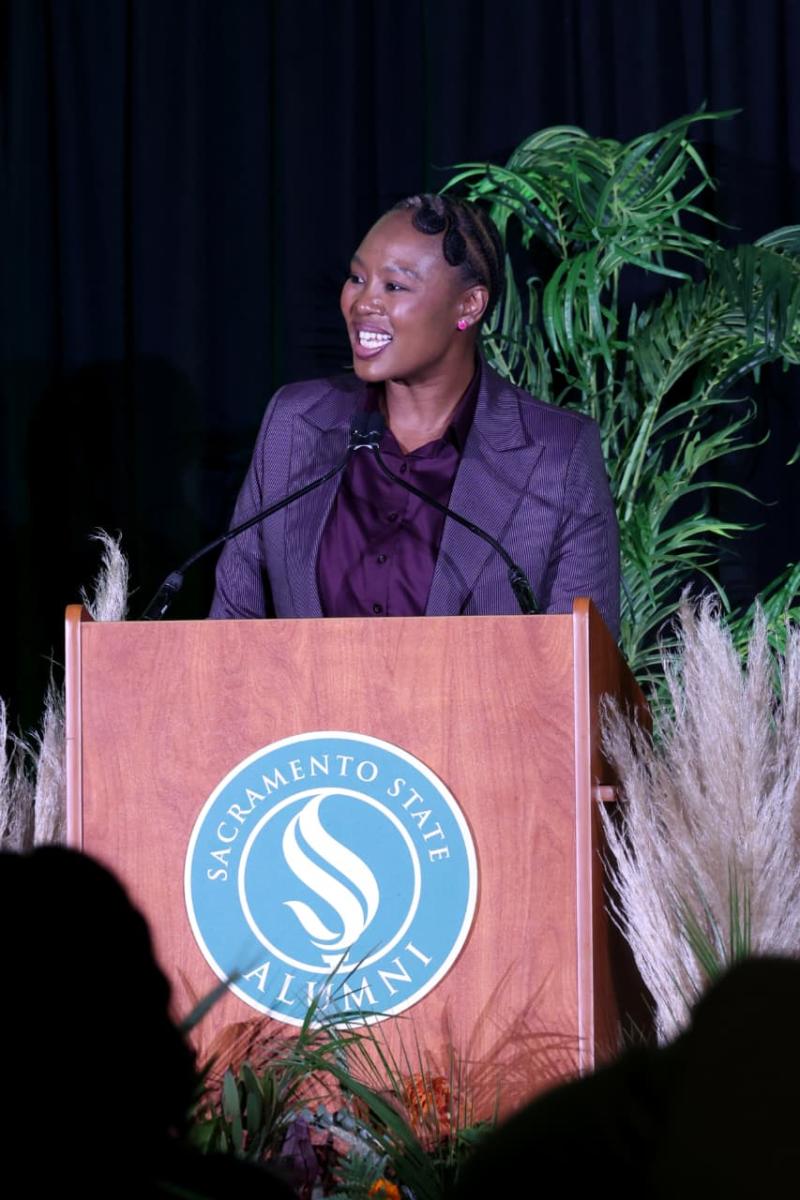
Sacramento, California - Minister of Small Business Development Stella Ndabeni has called for stronger collaboration between institutions of higher learning and entrepreneurs to ensure that knowledge generated through education is translated into practical solutions that address South Africa's socio-economic challenges.
The Minister said partnerships between universities, technical and vocational education and training (TVET) colleges and the business sector were critical to ensuring that research, innovation and technological advancements contributed meaningfully to economic development and job creation.
“Most governments pay a lot in education, but they do not get a return on investment. And this step is the step that seeks to address that gap,” she said.
Minister Ndabeni was speaking at the closing event of the South African delegation's engagement at Sacramento State University in California, United States, where she joined Minister of Higher Education and Training Buti Manamela and university leadership in reflecting on the day's engagements and opportunities for future collaboration.
The engagement formed part of President Cyril Ramaphosa's high-level working visit to the United States, which seeks to strengthen partnerships in technology, innovation, education and investment.
Minister Ndabeni said bringing institutions of higher learning together with entrepreneurs was important because it connected the production of knowledge with the practical application of solutions to challenges facing communities.
“When we begin to see institutions of higher learning responsible for the production of knowledge meeting with the entrepreneurs who must do the work and resolve the problems that are faced by our people, it brings joy to us to say, indeed, the solutions that entrepreneurs are trying to solve. One thing that is said is that they're going to be evidence-based, which is very critical,” the Minister said.
She said this approach would help ensure that government policies and educational investments translate into measurable socio-economic benefits.
The Minister emphasised that education should equip people not only with knowledge but also with the ability to use that knowledge productively and contribute to the development of their communities.
She said the collaboration between universities, TVET colleges and entrepreneurs could also help address unemployment by creating opportunities for people to turn their knowledge and skills into viable economic activities.
“To say if we have paid for people to go to school and acquire knowledge, that must be invested back in the communities that they come from, but most importantly to be able to change people's lives,” Ndabeni said.
AI must be accessible and inclusive
Turning to the role of artificial intelligence (AI) in economic development, Minister Ndabeni called for developing countries to become active participants in technological innovation rather than remaining consumers of technologies developed elsewhere.
She said South Africa needed to encourage the development of affordable technologies that responded to local challenges and ensured that communities were not excluded from the opportunities presented by the digital economy.
“As we talk about AI for public good, how do we make sure that our people do not only become consumers of the different technologies, but they also become inventors who must provide solutions, especially on affordable technologies for countries like ourselves, which are developing, because we can be talking about technologies that are available, but if people can't afford them, then it limits their access,” she emphasised.
The Minister cautioned that limited access to technology could deepen existing inequalities, particularly if the development and deployment of AI failed to consider the needs of developing countries.
She also highlighted the importance of ethical considerations in the development of AI systems, particularly the algorithms that inform how these technologies operate.
“And at the centre of that is ensuring that we pay attention to the ethics of the algorithms that are driving AI, because we do not want to see a repeat of the past where people are excluded, utilizing the same new economy instruments that we are building,” she said.
Minister Ndabeni said international collaboration was essential in ensuring that countries respected one another's cultural differences and sovereignty while working together to advance innovation and economic development.
She added that technological cooperation could create opportunities for knowledge exchange and business growth across geographical boundaries.
Strengthening education and people-to-people relations
Minister Manamela, who also addressed the closing event, said the engagements had provided an opportunity to exchange ideas on AI policy, its practical applications and the challenges associated with integrating the technology into classrooms.
He identified stronger cooperation on AI policy and student exchanges as important areas for future collaboration between South African institutions and Sacramento State University.
“I hope that the students may have found an interest in coming to study here for their doctoral and postdoctoral studies. We had a chat about that and to see which areas we can specifically focus on,” he said.
The Minister said the relationships built through educational exchanges were equally important, noting that people-to-people connections could help strengthen relations between countries beyond formal engagements between their leaders.
“We want to see this engagement moving beyond the University of South Africa and the Mangosuthu University of Technology. We have some academics here from the University of Johannesburg and the Nelson Mandela University, who've all indicated an interest to pursue a partnership with Sacramento University in one form or another and hopefully those discussions will yield positive results,” Manamela said.
He said education had an important role to play in building friendships and creating opportunities for people from different countries to learn from one another.
Students and businesses reflect on opportunities
Representatives of the business and student delegations also shared their reflections on the engagements, highlighting the value of networking, exposure to research and opportunities to develop partnerships.
Small and medium enterprise delegation representative Ashika Kirpal, Director: Transformation and Naspers Labs, said the engagements had provided participants with practical insights and action points, particularly around collaboration and public-private partnerships.
She highlighted the importance of understanding how different stakeholders could work together within an innovation ecosystem to develop solutions.
Kirpal also pointed to discussions around smart villages and the Black Honors College as valuable areas of learning for the South African delegation.
She said the delegation was returning home with networks and ideas that could be developed into practical initiatives, adding that participants were expected to present their action plans to the President within 90 days.
Student delegation representative Kgaogelo Chokoe said the university visits had exposed students to research and innovation in areas such as robotics, autonomous systems and artificial intelligence.
The students visited autonomous systems and robotics laboratories, where they observed research involving drones and robots working together through multi-robot collaboration.
One of the projects demonstrated involved drones capable of landing on moving robots, while researchers also showcased robotic systems being tested using cameras for indoor navigation and control.
Chokoe said the experience had demonstrated the importance of partnerships between universities, research institutions, and other stakeholders in advancing technological development.
The students also interacted with their counterparts at Sacramento State, toured the campus and attended presentations showcasing student-developed prototypes, including an AI application in architecture that could allow users to test design concepts before committing money to property development.
She said the experience had sparked interest among members of the delegation in pursuing further studies at the university and establishing student exchange opportunities.
Sacramento State University President Luke Wood highlighted the institution's commitment to creating an inclusive learning environment that supports students from diverse backgrounds.
He said the university viewed education as an important vehicle for socio-economic mobility and preparing students to transform, succeed, and lead.
Sacramento Mayor Kevin McCarty also highlighted the importance of cross-cultural understanding and educational cooperation between South Africa and the United States.
The closing event underscored the importance of strengthening institutional partnerships, expanding student and academic exchanges, and connecting research and innovation with entrepreneurship to support inclusive economic development. – SAnews.gov.za


