


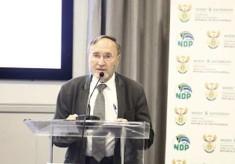
Water and Sanitation Deputy Minister, Dr Jack Bloom, says Gauteng can save billions of rands and improve water supply by reducing water losses, with a new national framework setting a target to bring non-revenue water (NRW) down to below 25% by 2035.
Bloom said Gauteng currently loses or fails to account for about 48% of its water, highlighting the need for urgent interventions to address leaking infrastructure, inaccurate billing and water theft.
Speaking at a workshop on the Strategic Framework for Water and Sanitation Services in Boksburg on Tuesday, Bloom said physical water losses through burst and leaking pipes alone amount to an estimated 431 billion litres annually.
“At Rand Water rates, this is about R7 billion a year and at municipal rates, it is probably more than double this figure, so at least R14 billion is revenue lost to municipalities,” Bloom said.
He said the situation is particularly concerning because many residents continue to experience unreliable water supply, with some communities relying on water tankers, while others faced interruptions, despite water flowing from broken pipes in their streets.
The Deputy Minister noted that the extent of water losses varies across Gauteng, with Johannesburg records NRW of about 49%, including physical losses of 26%, while Tshwane stands at 45%, with physical losses accounting for 34%. Ekurhuleni records NRW of about 30%, including physical losses of 22%.
“The worst non-revenue water is at Emfuleni (over 70%) and Mogale, which is over 60%,” Bloom said.
The new Strategic Framework updates the previous framework adopted in 2003, which focused primarily on expanding basic access to water and sanitation following the inequalities of apartheid.
Bloom said the 2026 framework aims to close the gaps in recognising that a tap without reliable and clean water is not access, and a pit toilet that is not regularly serviced is not dignity.
Bloom said that a household with a water connection, but no reliable supply of clean water, cannot be considered to have meaningful access, while sanitation facilities that are not properly serviced undermine dignity.
The Deputy Minister said the framework makes climate risk assessments and adaptation central to water services planning, while promoting the use of smart meters, digital asset registers and transparent reporting.
It also requires municipalities to plan for informal settlements, peri-urban communities and people living on private land.
“The framework calls for an independent economic regulator for water services to be legislated by 2029, separating regulation from the department’s other roles. Grants must fund repairs and renewal, not only new projects, because too many new projects fall into disrepair when they are not maintained,” the Deputy Minister said.
He added that water revenue must be ring-fenced, and lifecycle costing becomes compulsory.
Key targets
The framework sets several key targets for 2035, and these include:
• National NRW reduced to below 25% by 2035.
• Eighty percent of urban households to have smart meters by 2032.
• Water Services Authorities to renew at least 10% of high-risk ageing assets annually, with at least 30% of end-of-life pipelines, pumps and process units replaced by 2035
• Investment in water-services infrastructure to reach at least 0.75% of GDP by 2035.
• All schools and clinics to have adequate and safe water and sanitation services by 2035.
• Free basic water and sanitation policy implemented in all Water Services Authorities by 2035.
• One hundred percent compliance with SANS 241 potable-water standards by 2035.
Bloom said Gauteng will need to roughly halve its current water losses to meet the national target, adding that municipalities cannot afford to delay interventions until the deadline.
“Every leak fixed and every meter read correctly brings water to people who don’t currently have it,” he said.
Bloom said the framework and the workshops being held across the country aim to help close the gap between policy commitments and the actual delivery of reliable water and sanitation services. – SAnews.gov.za


