


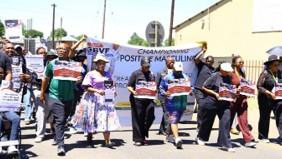
Women, Youth and Persons with Disabilities Minister Sindisiwe Chikunga has called on men and boys to challenge harmful gender norms and take an active role in preventing gender-based violence and femicide (GBVF).
Speaking at the launch of National Positive Masculinity Programme in Ermelo, Mpumalanga, on Friday, Chikunga said the campaign aims to promote responsible male leadership, respect for women and girls, and non-violent ways of resolving conflict.
Held under the theme: “Real Men and Boys Build, Protect and Transform”, the programme seeks to address attitudes and behaviours that contribute to gender inequality and violence.
“Positive masculinity means the opposite of violence and control. A good man is not measured by how much fear he creates, but by how much safety he creates,” Chikunga said.
She urged men and boys to use their strength, authority and influence to protect, support and care for others, while showing respect and taking responsibility for their actions.
The Minister said the fight against GBVF requires a collective response including government, civil society, faith and traditional leaders, employers, educators, parents and communities.
Chikunga said the programme was informed by the Human Sciences Research Council’s first South African National Gender-Based Violence Study, published in 2024. The study found that one in three women, aged 18 and older, have experienced physical and/or sexual violence in their lifetime.
It also found that 29.3% of women with disabilities have experienced physical violence in their lifetime, compared with 21.7% of women without disabilities.
According to Chikunga, the programme will use evidence-based interventions at individual, interpersonal, community and societal levels to address the drivers of violence.
These include improving access to mental health services and substance-use interventions for men, strengthening family support programmes and addressing childhood exposure to violence.
The programme will also introduce age-specific anti-violence initiatives in schools, places of worship, sporting organisations and traditional councils, while linking GBVF prevention to alcohol-abuse prevention, HIV prevention and women’s economic empowerment.
Chikunga said the rollout will build on an initial engagement in KwaZulu-Natal’s uMzinyathi District in March 2026, with structured pilot programmes planned for Mpumalanga, the Eastern Cape and the Free State before expansion to all nine provinces.
She said government is also strengthening its broader response to GBVF through the National Strategic Plan on GBVF, the National Council on GBVF, and the President’s Four-Point Plan announced on 29 September 2026.
The plan includes a 60-day audit of unresolved sexual offences and violent crimes against women and children, measures to reduce forensic backlogs, safety audits of high-risk public spaces and stronger enforcement against illegal liquor outlets.
Strengthening prevention and support services
Chikunga highlighted that additional funding has been allocated to strengthen prevention and support services. This includes R3.8 billion to employ more than 3 500 social workers and R186 million to strengthen forensic and investigative capacity.
Government is also expanding sexual offences courts from 55 to 101 and increasing the number of Thuthuzela Care Centres from 72 to 80 by 2028/29. A further R157.4 million has been allocated to the Department of Women, Youth and Persons with Disabilities to strengthen coordination and oversight of the national response to GBVF.
“These commitments and allocations demonstrate that government is not paying lip service to the fight against GBVF,” the Minister said.
However, Chikunga emphasised that funding and policy commitments need to be matched by effective implementation, accountability and measurable improvements in the safety of women and girls.
The Minister said positive masculinity must be demonstrated in everyday life, including when men challenge sexist behaviour among their peers, support women’s leadership, share caregiving responsibilities and hold perpetrators of abuse accountable.
The campaign also draws on the legacy of the 1956 Women’s March, which marked its 70th anniversary this year. Chikunga said engaging men and boys in changing harmful attitudes is part of the work needed to advance the equality for which women have fought.
“The war on GBVF cannot be won by one institution or one individual. It requires all of us. We are declaring that South African men and boys are ready to carry their share of that war.
“We are declaring that this government is resourcing the fight, that the evidence is informing our programming, and that the Positive Masculinity Programme we launch today will travel to every province, every district, every school, every workplace, and every household in this country,” Chikunga said. – SAnews.gov.za


