


Water and Sanitation Deputy Minister Jack Bloom has reiterated his call for greater community participation in tackling river pollution.
Bloom made the call at the official opening of an innovative set of litter traps on the Kaalspruit in Olifantsfontein, Ekurhuleni, where he joined residents and volunteers in a river clean-up operation.
Tuesday’s event highlighted efforts by environmental activist and artist Willem Snyman, founder of the Fresh NGO (Fountain River Environmental Sanctuary Hennops), to prevent plastic waste from flowing downstream into major river systems.
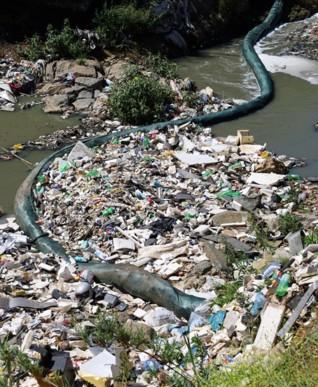
Over several years of trial and error, Snyman has installed eight polystyrene traps and seven lines of plastic-bag traps along the river and canyon. Most are suspended from 100-metre cables, with the installations spanning more than 800 metres.
The traps collect large volumes of waste, including polystyrene discarded by recyclers and illegally dumped building rubble. On some days, Snyman’s team fills a 30-cubic-metre skip with the collected material.
The project has also created employment opportunities for people from the surrounding community, who help clear the traps and remove the accumulated waste. Snyman has funded much of the initiative himself.
The Kaalspruit flows through Tembisa, with significant plastic pollution accumulating in the Olifantsfontein area before the river feeds into the Hennops and Crocodile rivers, which flow into Hartbeespoort Dam and eventually the Limpopo River.
Bloom highlighted the importance of intercepting waste close to its source to prevent further pollution, particularly during periods of heavy rain when litter can be carried downstream.
Once plastic waste spreads through river systems, he said recovering it becomes increasingly difficult, making interventions such as the Kaalspruit litter traps important in protecting water resources.
Bloom commended the partnership between Fresh NGO and the City of Ekurhuleni, which approved the installation of the traps on municipal land.
However, he warned that the traps need regular maintenance to remain effective, and that full traps could overflow or become blocked if they are not cleared.
“A litter trap only works, however, if someone empties it. Once a trap is full, it can overflow or block, so Fresh NGO needs volunteers and partners to keep the traps clear.”
The Deputy Minister called on residents, schools, businesses, and estate agencies in the area to support the initiative by volunteering, sponsoring the project or adopting a litter trap.
“Use the bins, do not dump, and report illegal dumping to the city. We must all be part of the solution to cleaning up our precious rivers.”
The initiative also carries a social message. Snyman is working on a memorial park for young women who were murdered in the area, including a victim whose body was found in one of the litter traps.
Bloom drew a connection between the pollution of the river and the scourge of gender-based violence, calling for efforts to restore both the natural environment and the safety and dignity of communities.
“It is not just litter that is dumped here. Serial murders of young women have taken place near here, and the body of one of the victims was found entangled in one of these litter traps. We need to cleanse this river, and we need to cleanse society of the evil of gender-based violence,” he said.
Bloom thanked Snyman and the Fresh NGO team, volunteers from the Clean Environment and Clean South Africa non-profit organisations, City of Ekurhuleni officials, and residents who participated in the clean-up.
“It is said that you eat an elephant one bite at a time – this is what we need to do with our polluted rivers, one section at a time, stopping the pollution at its source,” Bloom said. – SAnews.gov.za


