


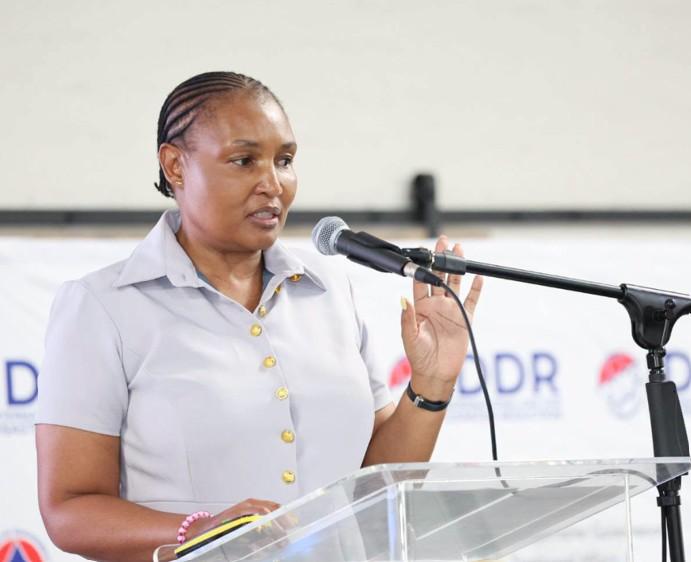
Human Settlements Minister Thembi Simelane has called for disaster risk assessments to be integrated into housing delivery, warning that poorly located developments and inadequate infrastructure can expose communities to foreseeable hazards.
The Minister said housing projects must be planned and implemented in ways that protect families from risks such as flooding and fires, while ensuring that settlements have reliable access to essential services.
“A home should give a family greater security. If its location or construction exposes that family to foreseeable harm, an essential part of our responsibility remains unfulfilled,” Simelane said.
Simelane was speaking during a panel discussion on risk-informed planning and safer communities at the International Day for Disaster Risk Reduction engagement held in Mbombela, Mpumalanga, on Wednesday.
Held under the theme: “Resilience Starts at Home”, the engagement focused on the role of housing delivery and spatial planning in reducing disaster risks and building safer communities.
Simelane emphasised the need for disaster risk assessments to be conducted before land is acquired and housing projects approved. These assessments must consider hazards, site conditions, climate projections and the infrastructure required to support settlements over the long term.
She warned that land with a low purchase price can ultimately prove costly if it requires extensive flood protection, has unstable ground, or cannot be reliably serviced.
The Minister also emphasised the need to coordinate land preparation, infrastructure provision and environmental assessments early in the project planning process to prevent delays and avoid development on unsuitable sites.
Municipal infrastructure, including drainage, water, sanitation, electricity and roads, is equally important in determining whether communities can withstand disasters.
“For flood-exposed communities, this means drainage designed for local conditions, functioning culverts, and development that respects waterways. For fire-exposed settlements, it means safe access for emergency vehicles, adequate water for firefighting, safer energy provision and layouts that reduce the spread of fire,” the Minister said.
She said these measures must be planned and funded alongside housing projects, with clear responsibility for infrastructure maintenance and repairs.
Simelane also stressed the importance of construction quality, calling for appropriate building materials, site-specific specifications and effective inspections to identify defects before homes are occupied.
Turning to existing informal settlements, the Minister said government must reduce residents’ exposure to hazards while longer-term housing solutions are being developed.
The Informal Settlements Upgrading Programme provides a framework for transforming unsafe and unserviced settlements into habitable, legally secured and sustainable neighbourhoods through in-situ upgrading or relocation, where necessary.
She said upgrading can include improved drainage, safer access routes and the reorganisation of settlement layouts to create space between structures and improve emergency access.
However, where serious risks cannot be adequately addressed on site, the Minister said relocation may be necessary, and in such cases, government must consult residents, explain the reasons for relocation, and provide credible alternative accommodation.
The Minister added that residents must receive interim protection while land acquisition, approvals and construction processes continue.
On funding and accountability, Simelane called for disaster prevention measures to be reflected in development budgets, warning that cutting essential infrastructure or site protection costs can result in greater expenses through displacement, repairs and repeated reconstruction.
She said housing projects must be assessed against their long-term costs, including maintenance and potential disaster losses, rather than the initial cost per housing unit alone.
The Human Settlements Development Grant, Urban Settlements Development Grant and Informal Settlements Upgrading Partnership Grant should be coordinated with municipal infrastructure programmes and disaster risk priorities, in line with their applicable frameworks and approved business plans.
Simelane further called for provincial housing plans, municipal integrated development plans, spatial development frameworks and disaster management plans to identify the same high-risk communities and set out the interventions needed to protect them.
She said oversight mechanisms must track whether identified risks have been addressed before occupation, whether upgrading projects were reducing exposure and whether construction defects had been corrected.
The Minister also highlighted the importance of community participation in disaster planning, noting that residents possess valuable knowledge about local flooding patterns, inaccessible routes and households that may need assistance during evacuations.
“An early warning is useful when people understand what it means and can act on it. Communities need accessible information, safe evacuation arrangements and assistance for people who cannot leave independently. Women, older people, and persons with disabilities must have a meaningful voice in those arrangements,” Simelane said.
She emphasised that community awareness cannot replace government’s responsibility to provide safe land, functioning services and effective technical oversight.
She further called for national and provincial government to assist municipalities facing shortages of planning and engineering expertise, warning that requiring technical assessments without providing the capacity to conduct them could leave projects stalled and communities exposed. – SAnews.gov.za


