

Government is investing R8.9 billion to restore the 861 km Iron Ore Export Line, strengthening a critical freight corridor that links Sishen in the Northern Cape to the Port of Saldanha in the Western Cape.
“The Transnet Rail Infrastructure Manager’s (TRIM) long-term Ore Line Restoration Programme, which runs until 2030, is valued at approximately R8.9 billion and is aimed at restoring reliability, improving capacity and supporting economic growth through a safe, efficient and reliable rail network,” Minister of Transport Barbara Creecy said during a site visit to the Iron Ore Line on Monday, held as part of the annual maintenance shutdown.
Creecy said the export corridor is vital to mineral exports, economic activity and thousands of jobs across the logistics value chain.
“This corridor is therefore far more than a railway line. It is an economic artery that supports exports, industrial growth and employment across our economy.
“When this corridor performs well, mines can move their commodities efficiently, exporters can reach international markets, ports can operate more effectively and businesses across the logistics value chain can grow. It also strengthens South Africa’s position as a reliable trading partner,” Creecy said.
Intensive maintenance during shutdown
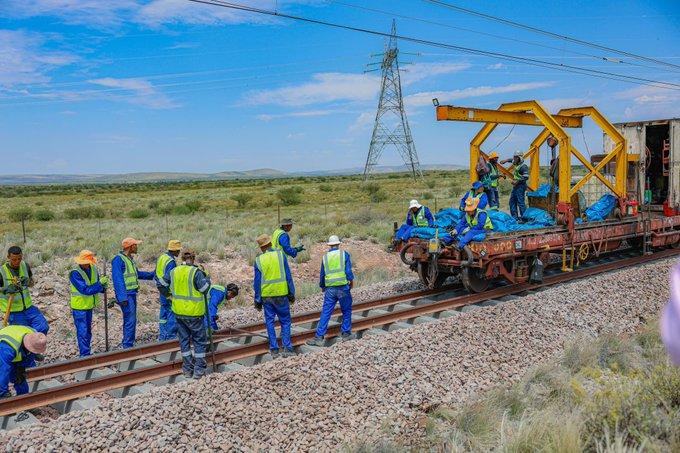
The annual maintenance shutdown, underway from 6 to 16 October, gives TRIM a dedicated window to carry out intensive work that would be difficult to complete while normal rail operations continue.
During the shutdown, teams are replacing rail and sleepers, screening ballast, replacing and maintaining turnouts, accelerating track maintenance, rehabilitating formations and installing culverts. Electrical and signalling maintenance is also underway.
“These may sound like highly technical activities, but ultimately they have a simple purpose: to build a safer, more reliable and more efficient railway.
“Safety is not separate from delivery. It is the foundation of delivery. The success of this shutdown will be measured not only by the maintenance completed, but by ensuring that every person returns home safely and that the corridor is restored to service without compromise,” the Minister said.
Funding rail and rolling stock renewal
To support the programme, government has allocated R3.4 billion through the Budget Facility for Infrastructure (BFI) over the current and next financial years.
This year, TRIM will invest approximately R2.2 billion in restorative maintenance on the Ore Corridor, including R1.5 billion funded through the BFI allocation.
Transnet’s efforts to improve operations on the line also include R1.47 billion for ore line rolling stock maintenance: R752.3 million for wagons and R721.9 million for locomotives.
Similar amounts will be allocated to rolling stock maintenance in the next financial year.
“These investments will support critical maintenance and overhaul programmes, including the 15GO and 43DGO locomotive overhaul programmes, while addressing long-standing maintenance backlogs and improving fleet availability, reliability and operational stability.
“Rail interventions are being complemented by strategic investments in the Port of Saldanha, ensuring an integrated corridor approach to restoring South Africa's iron ore export capacity,” Creecy said.
Port upgrades support export capacity
At the Port of Saldanha, the Transnet National Ports Authority (TNPA) is commissioning the Bulk Power Upgrade Project, representing a total capital investment of approximately R750 million.
The project will increase the port’s power supply, enabling Transnet Port Terminals to operate its third tippler and support higher export volumes through the port.
Jobs and opportunities for local businesses
“The benefits of a programme of this scale should not only be measured in kilometres of rail replaced or sleepers installed. We must also ask what this investment means for the communities through which this railway passes.
“For this October intervention, approximately 1,300 fixed-term contract opportunities have been created, with more than 600 indirect opportunities expected through associated economic activity,” the Minister said.
The programme also creates opportunities for small, medium and micro enterprises in civil works, track-related services, logistics, transportation, plant and equipment support, material supply, accommodation and other support services.
Larger contractors can extend these benefits through subcontracting and procurement from local enterprises.
Infrastructure investment underpins rail reform
“It is important that we view today's work within the broader context of South Africa's rail reform programme. Government has made a clear policy choice to restore rail as the backbone of our freight logistics system.
“A central component of this reform is opening the freight rail network to private train operating companies while retaining rail infrastructure in state ownership,” Creecy said.
She said establishing the Transnet Rail Infrastructure Manager had created a dedicated entity to manage and maintain the national rail network and provide access to it. The Network Statement sets out the framework through which train operating companies can gain access.
“However, open access cannot succeed through policy and regulation alone. We need infrastructure that can turn reform from policy into practical implementation.
“Train operating companies must have confidence that when they invest in locomotives, wagons, people and operations, the infrastructure on which those investments depend is progressively becoming safer, more reliable and more predictable.
“That is why maintenance interventions such as the one we are witnessing today are fundamental to rail reform. We cannot invite greater volumes onto the railway without investing in the infrastructure that must carry those volumes,” Creecy said. -SAnews.gov.za


