

Deputy President Paul Mashatile has called for stronger implementation of the District Development Model (DDM), emphasising that government plans must translate into measurable results in people’s lives.
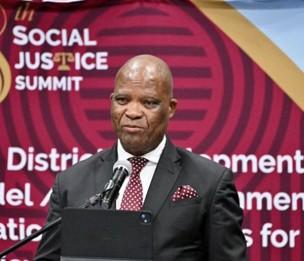
Delivering the keynote address on Mashatile’s behalf during the 8th Social Justice Summit at Stellenbosch University in the Western Cape on Monday, Deputy Minister of Cooperative Governance and Traditional Affairs (CoGTA) Namane Dickson Masemola said the success of the model must be measured by its impact on communities.
“The success of the DDM will not be measured by the number of plans produced, but by the positive impact it has on people's lives,” Masemola said.
Held under the theme: "The District Development Model (DDM) Inter-Governmental Relations as Catalysts for Achieving Sustainable Development Goals (SDGs) and Social Justice", this year’s summit underscores the importance of cooperation across all spheres of government in driving development, improving service delivery and advancing social justice.
The model, guided by the principle of “One District, One Plan, One Budget”, aims to improve coordination between national, provincial and local government, align resources and address fragmented planning and implementation.
Masemola said the challenges of poverty, unemployment, inequality and uneven access to services cannot be addressed by any institution acting alone.
“They require coordinated action, shared responsibility and a steadfast focus on the needs of our people,” he said.
Masemola said all district and metropolitan areas have now developed One Plans, providing a foundation for integrated planning and investment. The task is to ensure effective implementation and measurable results.
“Encouraging progress has already been recorded in areas such as infrastructure development, water security, healthcare and local economic development. These examples demonstrate the value of coordinated action and partnership across government.
“However, communities rightly judge success by outcomes. They want reliable services, quality infrastructure, access to economic opportunities and safer neighbourhoods. Development must be visible and tangible in everyday life,” the Deputy Minister said.
He highlighted five priorities for strengthening the model, and these include accelerating funded and achievable projects; strengthening alignment between planning and budgeting; building institutional capacity, particularly in infrastructure delivery and financial management; expanding partnerships with business, academia, civil society and communities; and measuring success through improved services, economic inclusion and better living conditions.
At its core, the DDM is about building a capable, responsive and developmental state that works as one to serve the people of South Africa, Masemola said.
“The DDM gives practical effect to this vision by promoting integrated planning and coordinated implementation. It recognises that challenges such as housing, healthcare, education, infrastructure and economic development are interconnected and therefore require integrated solutions.
“This approach remains particularly important as South Africa continues to address the enduring legacy of apartheid, which left deep spatial, social and economic inequalities. Advancing social justice requires deliberate efforts to overcome these disparities and expand opportunity for all,” Masemola said. – SAnews.gov.za


