


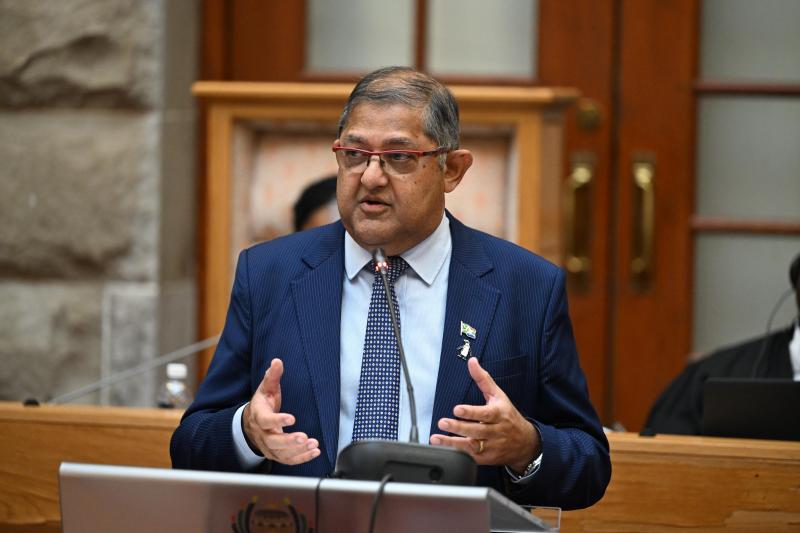
By Narend Singh
South Africa stands at an important crossroads. As we confront the realities of climate change, rising resource costs, unemployment, and increasing pressure on municipal waste systems, we face a simple choice: continue with an outdated economic model that treats resources as disposable, or embrace a circular economy that transforms waste into opportunity.
The choice should be clear.
For decades, our economy has largely followed a linear path: we extract, manufacture, consume, and dispose. While this model has supported industrial growth, it has also generated enormous environmental costs and placed increasing pressure on our natural resources and public infrastructure.
Today, the circular economy offers a different vision. It challenges us to see waste not as the end of a product's life, but as the beginning of a new economic opportunity.
Around the world, countries are recognising that circularity is no longer simply an environmental ambition. It has become an important driver of competitiveness, innovation and industrial resilience. South Africa cannot afford to be left behind.
Fortunately, we have already begun laying the foundations for this transition.
Government's Extended Producer Responsibility (EPR) Regulations represent one of the most significant policy interventions undertaken in the waste management sector in recent years. These regulations require producers to take responsibility for the environmental impacts of their products throughout their life cycle, creating incentives for better product design, greater recycling and stronger investment in collection systems.
Importantly, EPR is about far more than regulatory compliance.
When implemented effectively, it creates jobs, supports small enterprises, stimulates innovation and reduces the financial burden on municipalities that are increasingly struggling to manage growing waste volumes. It strengthens local manufacturing by returning valuable materials to productive use while reducing dependence on virgin resources.
The plastics sector provides an excellent example of this opportunity.
Too often, plastics are viewed only through the lens of pollution. Yet plastics remain essential to modern society, supporting industries ranging from healthcare and agriculture to construction and food security. The challenge is therefore not the material itself, but how we manage it.
Keeping plastics circulating within the economy through reuse, repair and recycling reduces pollution while unlocking significant economic value. It creates new business opportunities, strengthens local value chains and supports thousands of livelihoods across the recycling economy.
This is why partnerships between government, industry and Producer Responsibility Organisations such as Polyco have become increasingly important. Their work demonstrates what can be achieved when regulation is matched by innovation, investment and collaboration.
Government remains committed to strengthening these partnerships.
The Department of Forestry, Fisheries and the Environment is currently reviewing the implementation of the EPR Regulations after five years to ensure that the system remains effective, transparent and responsive to emerging challenges. At the same time, through support from the Global Environment Facility, we are identifying practical interventions that can accelerate South Africa's transition towards a circular plastics economy.
These initiatives align closely with the country's broader industrial development agenda, which increasingly recognises circular economy principles as central to long-term economic competitiveness. However, regulation and policy alone will not deliver the transformation we seek.
Success will depend on collaboration across society.
Municipalities require stronger waste management infrastructure. Businesses must continue investing in product innovation and recycling systems. Communities need greater access to separation at source programmes. Waste pickers, who already make an invaluable contribution to recycling, deserve greater recognition, formal integration and fair economic opportunities.
Most importantly, we must change how we think about waste itself.
Across the country, encouraging examples are already emerging. Wastewater is being transformed into a valuable resource that strengthens water security. Former landfill sites are being repurposed to generate renewable energy. Materials once destined for disposal are creating employment, supporting entrepreneurs and reducing environmental pollution.
These are not isolated success stories. They are early signs of the economy we can build.
South Africa also has an opportunity to provide leadership beyond our own borders. Through our role as co-chair of the Africa Circular Economy Alliance, we are working alongside our continental partners to mobilise investment, strengthen circular economy initiatives and promote more sustainable approaches to resource management across Africa.
The transition to a circular economy is therefore not simply an environmental imperative. It is an economic development strategy, an industrial policy opportunity and a pathway towards greater resilience. Protecting our environment and growing our economy are not competing objectives. When approached thoughtfully, they reinforce one another.
The circular economy allows us to reduce pollution while creating jobs. It enables us to conserve resources while strengthening industrial competitiveness. It supports climate action while improving the quality of life in our communities.
This is precisely the kind of inclusive growth South Africa needs.
Our shared challenge now is to move beyond viewing sustainability as a compliance obligation and instead recognise it as a catalyst for innovation, investment and prosperity.
If government, industry, municipalities and citizens continue working together, we can build an economy that wastes less, creates more and leaves a healthier, more prosperous country for future generations.
*Singh is the Deputy Minister of Forestry, Fisheries and the Environment


