


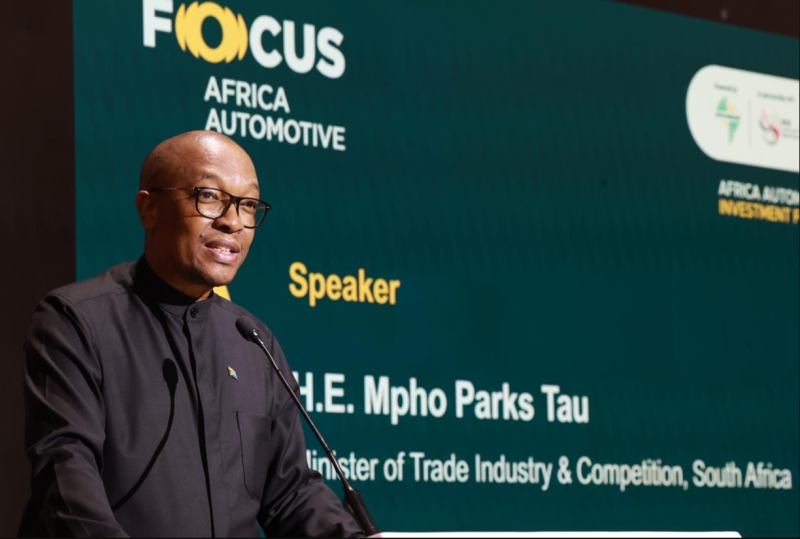
El-Alamein, Egypt -South Africa has called for stronger regional cooperation, increased investment and deeper industrial integration to build a competitive African automotive industry capable of creating jobs, expanding trade and strengthening the continent’s position in global markets.
Delivering an address at the Africa Automotive Investment Forum hosted by Afreximbank at the Rixos Hotel Alamein in Egypt, Minister of Trade, Industry and Competition Parks Tau emphasised the importance of translating Africa’s automotive ambitions into practical investment projects, manufacturing capacity and sustainable economic opportunities.
The forum was held on the margins of the inaugural Alamein Africa Forum.
Headquartered in Egypt, Afreximbank is a multilateral financial institution established to facilitate, promote and expand both intra-African and extra-African trade.
In his address on Friday, the Minister highlighted the need for governments, financiers, vehicle manufacturers, suppliers and investors to work together to develop bankable projects, strengthen regional value chains and increase investment in automotive manufacturing.
He also stressed the importance of using the African Continental Free Trade Area (AfCFTA) to expand intra-African trade and support industrial development.
Africa has produced approximately 1.23 million vehicles overall, representing about 1.3% of global production. South Africa produced approximately 618,077 vehicles in 2025, while Morocco reported reaching one million vehicles in production in December 2025. Together, the two countries accounted for more than 91% of Africa’s vehicle production.
“Africa still accounts for a small share of global automotive production, but the continent has strong foundations to build on,” he said.
To expand the continent’s manufacturing capacity, the AfCFTA Automotive Fund, supported by Afreximbank’s US$1 billion facility for local content development, is expected to contribute to efforts to strengthen local production and supplier networks.
Longer-term continental ambitions include increasing Africa’s vehicle production to between four million and five million vehicles by 2035, including new energy vehicles and related components.
The AfCFTA Automotive Fund, supported by Afreximbank’s US$1 billion facility for local content development, gives practical expression to this ambition, while continental automotive work points to a longer-term objective of producing 4–5 million vehicles in Africa by 2035, including new energy vehicles and related components.
Automotive Pact
The Minister also spoke about the proposal for an Automotive Pact Between SACU (Southern African Customs Union) and Egypt - A SACU-Egypt Auto Pact.
“The concept of automotive pacts within Africa has been under consideration for some time, including the work undertaken by the African Association of Automotive Manufacturers (AAAM).”
He further added that industry has long argued for Africa to build a viable and competitive automotive manufacturing sector. He added that leading automotive economies on the continent will need to cooperate in a more structured way through industrial and trade arrangements that promote complementarities rather than fragmentation.
Within SACU, this thinking has informed consideration of possible automotive pacts with key African partners, including Egypt and Algeria.
“The proposal for these Industrial Participation Agreements (IPAs) was presented to SACU structures as part of broader discussions on regional industrialisation, value chain development, and strategic responses to changes in the global trading environment.
SACU has noted the increasing importance of developing resilient African production systems in light of heightened protectionism, supply chain vulnerabilities, and the growing market access uncertainty in traditional markets.
“Against this backdrop, SACU sees value in exploring structured partnerships with major African economies such as Egypt to strengthen developmental integration and expand intra-African trade,” he explained.
A SACU-Egypt Automotive Pact presents the following opportunities:
- Support economies of scale in production and trade.
- Encourage complementary production patterns rather than duplication of small-scale production of similar competing models in separate markets.
- Increase intra-Africa trade in new vehicles and components.
- Facilitate trade diversion towards African suppliers, where commercially viable.
- Create a viable basis for supplier development and feeder industry growth.
The Minister added that through the South African Automotive Master Plan 2035, government and industry are working together to expand production, deepen local content, increase participation by black-owned and women-owned firms, strengthen supplier capability and use regional markets as a springboard for sustained industrial growth.
He said the country is also seeking investment across the full automotive value chain. This includes vehicle assembly for passenger vehicles, light commercial vehicles, buses and trucks.
Investment
In addition, he said South African firms are ready to invest outward into African markets in assembly, components, dealerships, after-sales services, logistics, charging infrastructure, battery value chains, industrial park development and supplier partnerships.
He further added that Egypt is a particularly important partner for several reasons. This is because it is one of the continent’s largest and most diversified economies, with substantial industrial capacity, a large domestic market, and a strong geographic position linking Africa, the Middle East, and Europe.
Minister Tau is part of President Cyril Ramaphosa’s delegation to the 8th African Union (AU) Mid-Year Coordination Meeting (MYCM).
READ | President Ramaphosa to lead SADC Participation at the AU Mid-Year Coordination Meeting
President Ramaphosa is set to lead the Southern African Development Community’s (SADC) participation at the meeting on Sunday.
-SAnews.gov.za


