


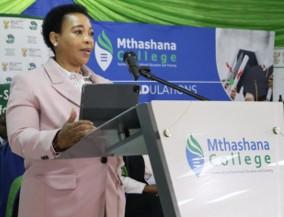
Higher Education and Training Deputy Minister Nomusa Dube-Ncube has urged graduates of Technical and Vocational Education and Training (TVET) colleges to use their technical skills to create employment, establish businesses and contribute to economic development in rural communities.
Dube-Ncube made the call during the 2026 Graduation ceremony at Mthashana TVET College in Vryheid Engineering Campus, KwaZulu-Natal on Thursday.
Addressing the graduates, Dube-Ncube emphasised that TVET is central to building a skilled workforce and addressing the country’s economic needs.
She encouraged graduates to see their qualifications as a stepping stone to further learning, entrepreneurship and opportunities in the global labour market.
“Being rural is your address, not your destiny. Rurality does not condemn anyone to poverty, provided you choose to grab the opportunities that are available,” Dube-Ncube said.
The Deputy Minister highlighted the role of artisans and technicians in keeping the economy running, noting that skills acquired at TVET colleges are essential to sectors such as manufacturing, agriculture, mining, construction and services.
She reiterated the need to change the perception that TVET colleges are a second choice for students who cannot access universities, pointing to countries such as Germany, Switzerland and Singapore, where vocational education is an established and respected pathway to employment and economic advancement.
“No nation has become prosperous without a strong, respected technical and vocational education system. Developed countries did not become developed and then build TVET systems. They built strong TVET systems, and that is part of how they became developed,” Dube-Ncube said.
The Deputy Minister said government has placed TVET colleges at the centre of its skills development agenda, with President Cyril Ramaphosa announcing the strengthening of the institutions as primary sites for occupational training and artisan development, during his 2026 State of the Nation Address.
She said the Department of Higher Education and Training’s 2026/27 Annual Performance Plan is targeting more than 520 000 enrolments at TVET colleges, including the creation of 91 800 workplace-based learning opportunities, and support for 22 000 artisan certifications.
Dube-Ncube also highlighted the importance of partnerships between colleges and industry for workplace-based learning in preparing graduates for labour market demands.
The Deputy Minister also highlighted South Africa’s recent participation in the WorldSkills International Competition in Shanghai, China, where 29 young people competed across 27 skills categories.
Among the achievements included Matthew Bowen, who won a silver medal in Aircraft Maintenance, making South Africa the first African member country to secure a medal in the category in the competition’s 75-year history.
Bowen, who received training from Intelek Training and Consultation at Rand Airport, was also undertaking workplace training at Solenta Aviation while competing.
Dube-Ncube said his achievement demonstrates the value of combining technical education with practical workplace experience and shows that young people from rural communities can also compete at the highest international levels.
She challenged management at Mthashana TVET College to identify talented students early and enter them into regional and national skills competitions, with the aim of preparing them for international platforms.
“I want to see a Mthashana student wearing the South African colours at the next WorldSkills Competition. Why not? Why not you?” she said.
The Deputy Minister also encouraged graduates to explore entrepreneurship, particularly in agriculture, tourism and agro processing, to stimulate economic activity and create jobs within their communities.
She said the region has significant agricultural potential and urged young entrepreneurs to process and package locally produced goods rather than allowing raw products to leave the district and return as more expensive finished products.
Dube-Ncube also encouraged graduates to make use of support offered by the Small Enterprise Development and Finance Agency and the National Youth Development Agency, including training, mentorship and financial assistance.
She further urged young people to embrace digital opportunities, noting that access to the internet has created new possibilities for rural entrepreneurs to acquire skills, market products internationally and work remotely.
The Deputy Minister called on lecturers to continuously upgrade their skills to keep pace with changes in the world of work, including artificial intelligence, automation, renewable energy, electric vehicles and digital systems.
She also challenged lecturers to pursue professional qualifications, participate in industry placements, and embrace digital and blended teaching methods to ensure that students acquire relevant, up-to-date skills. – SAnews.gov.za


