


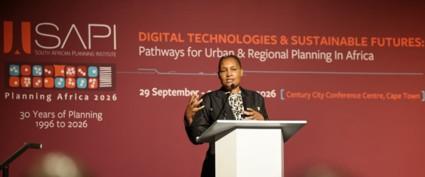
Human Settlements Minister Thembi Simelane has urged urban planners to develop practical solutions to regenerate deteriorating inner city areas, expand affordable housing and improve the safety of residents.
Simelane said the regeneration of inner cities should be integrated with affordable housing, infrastructure renewal, public safety, and the protection of residents’ rights to ensure that urban areas remain accessible to people of different income groups.
Addressing the South African Planning Institute’s 10th Planning Africa Conference in Cape Town on Thursday, the Minister raised concern about abandoned, unsafe and unlawfully controlled buildings, which pose risks to residents, surrounding communities and the functioning of cities.
The Minister said building hijacking and the unlawful exploitation of properties require appropriate law enforcement, legal and municipal interventions. She, however, warned against treating vulnerable residents living in these buildings as criminals.
“The solution is, therefore, not confined to enforcement. It must form part of an integrated approach to inner-city regeneration, the protection of occupants’ rights, safer buildings, and access to well-located accommodation,” Simelane said.
Simelane called on planners to assess underutilised buildings, property ownership, land-use rights, infrastructure capacity and development feasibility to identify opportunities to convert suitable properties into affordable rental accommodation or social housing.
She said partnerships between municipalities, social housing institutions, development agencies, property owners, and responsible private investors can help restore productive uses to inner-city buildings while expanding access to housing close to economic opportunities.
Simelane also urged the planning profession to develop practical, socially responsive and legally sound proposals that will prevent inner cities from deteriorating while low-income households continued to be pushed towards the urban periphery.
The Minister also highlighted the potential of digital technologies to improve urban and regional planning.
“Geographic information systems, remote sensing, modelling and improved data management can help planners strengthen decisions and give institutions a more reliable view of the work that needs to be done,” the Minister said.
She said climate resilience must also be incorporated into planning from the earliest stages of development, with flood risks, stormwater management, extreme heat and water scarcity informing land identification, settlement layouts and infrastructure investment.
Simelane further called for innovative approaches to address the challenges facing informal and rural settlements, urging planners to use technology to improve development planning and implementation.
She said the success of the planning profession must ultimately be measured by improvements in people’s living conditions rather than the number of plans produced.
“It [success] will be judged by whether more people can live in safe, well-located settlements, enjoy security of tenure, access economic opportunities and build sustainable livelihoods,” the Minister said.
Simelane encouraged planners to work closely with government, challenge ineffective processes and provide evidence-based recommendations that can be implemented to advance spatial justice and sustainable development.
She reaffirmed the department’ commitment to working with the planning profession to use technology and innovation to support inclusive development and build sustainable communities.
The three-day conference held in Cape Town from 29 September to 1 October 2026, was convened under the theme: “Digital Technologies and Sustainable Futures: Pathway for Urban and Regional Planning in Africa.”
The conference brought together government representatives, academics, researchers, professional planners, and development partners to discuss the future of planning on the continent. – SAnews.gov.za


