


With 42 days remaining before the Local Government Elections on 4 November 2026, political parties and independent candidates contesting the polls have reaffirmed their commitment to upholding the Electoral Code of Conduct and the supporting Code on Countering Disinformation.
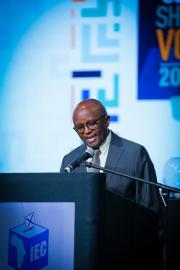
Speaking at the National Electoral Code of Conduct Signing and Ballot Paper Draw Ceremony in Midrand, Gauteng, on Wednesday, Electoral Commission (IEC) Chairperson Mosotho Moepya said signing the Code would ensure that all 136 790 candidates have an equal opportunity to campaign and communicate their messages without fear or unfair distortion.
“Violations of this Code distort the electoral playing field and undermine the fundamental principle of constitutional equality. As political party leaders step forward today to publicly pledge their allegiance and sign this Code, they are promising to confront public disillusionment head-on.
“They are committing to conduct their campaign ahead of the 4 November Local Government Election in a manner that restores trust, builds institutional integrity, and demonstrates that the democratic process can be responsive, clean, and accountable,” Moepya said.
By adhering to the Code, contesting political parties and independent candidates promise to:
- Condemn political violence: Speak out firmly against political violence, intimidation, sabotage and threats directed at political opponents, the public, the Electoral Commission and the media.
- Maintain clean campaigns: Run campaigns that respect the right of all citizens to express their political beliefs free from coercion.
- Elevate political discourse: Foster an environment in which democratic contestation is defined by robust, respectful and responsible debate on ideas, policies and service delivery, rather than vitriol, deception and division.
Moepya said an unhindered, independent press is a foundational pillar of free and fair elections.
“To ensure that our citizens receive accurate and meaningful information, Article 8 of the Electoral Code of Conduct explicitly sets out the strict relationship between political parties, candidates, and the news media,” he said.
Article 8 sets out explicit duties for every registered party and candidate:
- Respect the press: They must respect the indispensable role of the media before, during and after the elections.
- Guarantee access: They may not prevent members of the media from accessing public political meetings, marches, demonstrations and rallies.
- Ensure journalists’ safety: They must take all reasonable steps to ensure that journalists are not subjected to harassment, intimidation, danger, threats or physical assault by any of their representatives or supporters.
“In practice, this means political leaders and candidates must actively refrain from, and robustly protect journalists against, any harassment or harm - whether physically on the ground covering election gatherings or digitally online.
“No personal details or private information of a journalist—including their home addresses, personal contacts, or details of their loved ones—may be posted online. Doxxing is a severe violation of human rights and electoral decency that can lead to physical harm,” the Chairperson said.
He stressed that journalists must never be singled out at political rallies in ways that could provoke hostile or harmful conduct.
“They must be assisted when requesting information and allowed to cover political events in a safe environment, with concrete measures taken to safeguard both their physical safety and their technical equipment,” Moepya said.
To help ensure that voters’ choices are informed by accurate and credible information, the IEC officially promulgated the Electoral Code of Conduct on Countering Disinformation in Local Government Elections on 4 September 2026.
The Disinformation Code is legally linked to the broader Electoral Code of Conduct under section 88(a) of the Municipal Electoral Act.
The regulatory mechanism imposes strict obligations on every party, candidate and supporter:
- Verify content: All contestants have a positive legal duty to verify the factual accuracy of any content they publish, share or distribute.
- Correct errors within 36 hours: If false or misleading information is inadvertently published, parties must issue a clear public retraction and correction within 36 hours of becoming aware of the error.
- Prohibit deceptive uses of AI: The Code explicitly prohibits coordinated misinformation networks, shadow accounts, sock puppets and deceptive generative AI. If artificial intelligence is used to create campaign material or paid advertisements, it must be prominently, explicitly and clearly labelled.
The Chairperson warned that breaches of the Disinformation Code carry the same legal consequences as violations of the core Electoral Code of Conduct.
“The Electoral Court has full jurisdiction and authority to adjudicate these complaints and issue severe penalties, including hefty fines, criminal prosecutions, and the outright deregistration of non-compliant political entities. We have partnered with the digital tracking platform Real411 to allow citizens, candidates, and parties to report suspected digital breaches instantly,” he said. -SAnews.gov.za


