


By Dikeledi Molobela
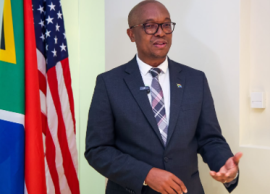
New York, USA — South Africa is moving beyond discussions on economic growth and industrialisation towards implementing concrete projects and partnerships across the continent said Trade, Industry and Competition Minister Parks Tau.
Tau was reflecting on engagements held on the margins of the United Nations General Assembly (UNGA) High-Level Week, including a South African Business Impact Initiative (SABII) roundtable, where government and business explored opportunities to strengthen South Africa’s industrial capacity, expand trade and investment, and deepen economic integration across Africa.
The Minister said the roundtable provided an opportunity to assess South Africa’s economic position and identify areas where government and business could collaborate to unlock growth.
“Today was really a business forecast day for South Africa, but also in Africa. The roundtable itself looked at areas of partnership, areas of collaboration and collaboration for the growth of South Africa, but also collaboration with the African continent,” Tau said on Monday.
The discussions included the African Continental Free Trade Area (AfCFTA), rules of origin, market access, automotive manufacturing, Special Economic Zones (SEZs), and financing and opportunities for South African businesses to participate more deeply in the industrialisation of the continent.
Deepening AfCFTA opportunities
The Minister told SAnews that discussions on the AfCFTA focused on the progress being made in agreeing on rules of origin and identifying products and sectors where African countries could collaborate to expand production and trade.
“We reflected in our discussions on the Africa Continental Free Trade Area, the opportunities it provides from the point of view of agreeing on rules of origin, which products can be exporting to Chinese markets, which are the areas where we can have joint collaboration, particularly the more recently adopted automotive pact,” he said.
He said South Africa is engaging automotive-producing countries on the continent to explore how their respective manufacturing capabilities could complement each other and contribute to the growth of the industry.
The discussions form part of the broader industrialisation agenda outlined by the Department of Trade, Industry and Competition, which has identified regional integration and diversification as important elements of South Africa’s industrial strategy.
Cross-border SEZs
A key area discussed was the expansion of South Africa’s SEZ model beyond national borders, with Tau saying government is exploring cross-border special economic zones as a way of strengthening regional value chains.
“We shared the work that we're doing to ensure that we expand our views of special economic zones from being South Africa centric to being Africa centric special economic zones.
One initiative involves South Africa, Mozambique and Eswatini, with discussions underway to establish a cross-border SEZ.
“We are working with the DP World, that’s of course the port manager and the anchor investor in the Maputo port, but it is also in the Nkomazi SEZ, which is on the border of Mozambique and ESwatini and we're talking about the creation of a cross-border special economic zone that covers South Africa, Eswatini, and Mozambique.”
He said the three countries were working towards concluding an agreement before the end of the year.
The Minister also highlighted discussions around the Beitbridge border post, describing the corridor as strategically important for trade into Zimbabwe and the wider continent.
“We also engaged in discussions on a cross-border special economic zone that's looking at the Beitbridge border,” he said, adding that it is an important corridor for the continent.
Tau said the objective is to improve the movement of goods by creating a more integrated border system.
“It's an integrated port from both points of view, and this is about improving the ability of products to move with ease into the continent and into the region,” he said.
Projects
Tau said the roundtable also considered how public and private sector funding could be mobilised for projects across Africa, including mechanisms to reduce investment risks.
“We also had discussions on funding, funding from the private sector, funding from the public sector. We're talking to international institutions around de-risking funding. We're talking about investments on projects into the African continent with input from South African banks about the role they can play in this regard,” he explained.
He said the discussions were significant because participants were increasingly focused on implementation rather than simply identifying challenges.
“So, with conversations that are very productive, conversations that are moving us forward, and all of us agree that we are beyond discussion now. Let us talk about actual projects,” Tau said.
Discussions were also aimed at positioning South Africa as a key investment and growth hub on the continent while strengthening its links with international markets.
“I'm excited that we collectively agreed that we are placing South Africa on the pedestal as one of the key countries for investment, but also one of the key growth nodes of the continent and internationally. We are also talking with the rest of the world on how they fit into investment, development and trade with South Africa and the African continent.”
The approach is consistent with the department’s stated focus on moving from industrial policy formulation to implementation, using instruments including SEZs, infrastructure investment, development finance, public-private partnerships and trade agreements to translate policy into investment, exports and jobs.
Youth employment and skills
The Minister said the engagements also included discussions on the Youth Employment Service (YES) and other programmes aimed at expanding opportunities for young South Africans.
“We had bilateral discussions with a group of South Africans, particularly looking at the Youth Employment Services Initiative and how we can enhance the YES program and other similar programs in the country and maximise the impact these have on youth development, youth entrepreneurship, skilling young people, but also on on-the-job learning,” he said.
Tau emphasised the importance of practical work experience for young people entering the labour market for the first time.
“It is important, particularly for young people that have not had a first opportunity into a job to get on-the-job learning, because it is that experiential learning that enhances your capabilities.”
He said discussions also covered an entrepreneurial pathway for young people and regulatory reforms that could support their participation in the economy.
Mauritius seeks stronger industrial partnership with SA
Tau also held bilateral discussions with the Minister of Industry, SME and Cooperatives Sayed Muhammad Aadil Ameer Meea of Mauritius.
Trade, investment and industrial cooperation were among the issues discussed.
Mauritius expressed an interest in strengthening South African investment to support the diversification and industrialisation of its economy.
The Minister said Mauritius had expressed interest in strengthening its relationship with South Africa beyond trade with Mauritius seeking a partnership focused on manufacturing and industrialisation as it works to diversify its economy beyond services and tourism.
“Mauritius has said to us that they don't just want to see South Africa only as a trading partner.We would want you to come and help us industrialise our own economies.
“So, see yourselves not as people that export products into our economies but see South Africa as the investors that come into our countries and help us to produce goods. And that's what Mauritius said they would want us to do,” the Minister said.
The discussions also covered the sugar industry with Mauritius being a major sugar producer and exporter, as well as opportunities to balance the protection of domestic industries with improved market access.
Tau said the broader objective was to deepen industrial cooperation, improve trade and investment opportunities and reduce barriers between African economies.
From policy to production
The engagements come as South Africa seeks to accelerate implementation of its industrial development agenda, with the revised Industrial Development Strategy focused on decarbonisation, digitalisation and diversification.
The strategy identifies sectors including automotive, manufacturing, mining, agro processing, the digital economy and green industries as areas for further development.
For Tau, the discussions in New York ultimately centred on converting these ambitions into tangible economic activity.
The Minister said the focus should now be on projects that can create productive capacity, strengthen regional value chains, attract investment and expand opportunities for young people.
His message to business was reflected in his speaking notes for the SABII roundtable: “We are moving from ‘what should South Africa do?’ to ‘what can we build together?’”
The Minister said this approach would position South Africa not only as a market and source of resources, but as a platform for manufacturing, innovation and access to African and global markets. – SAnews.gov.za


