


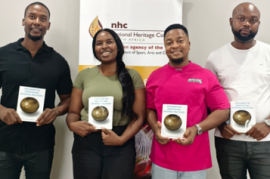
In a challenging economic environment, the Presidential Employment Stimulus Programme (PESP) is creating opportunities for young people to gain valuable work experience while helping to preserve South Africa’s rich cultural heritage for generations to come.
The PESP is part of the broader Presidential Employment Stimulus, launched by President Cyril Ramaphosa in October 2020 to help create and protect jobs and provide employment opportunities during a period of significant economic hardship.
While the broader stimulus supports employment across a range of sectors, the PESP focuses specifically on South Africa’s creative, cultural and heritage sectors. Through the programme, the National Heritage Council (NHC) of South Africa supports impactful, community-based heritage initiatives that create work opportunities, particularly for women, youth and persons with disabilities.
The NHC is a statutory body responsible for the preservation, protection and promotion of the country’s heritage.
Positive Change Youth Foundation
Among the beneficiaries of an earlier PESP funding window was the Positive Change Youth Foundation, a non-profit organisation working to strengthen heritage knowledge among young people.
Through its PESP-supported project, the organisation managed to create 68 work opportunities for local people in Mmakau, in North West, demonstrating how investment in heritage can also create pathways to employment and skills development for communities.
“These were fixed-term contracts for the duration of at least five months for technical work and one-month contracts for lesser-skilled roles. While the jobs were temporary, the training and experience improved participants’ prospects for future work in heritage and education,” said the foundation’s Project Manager, Khutso Raphepele.
He added that the organisation operates in a largely semi rural environment where poverty, limited infrastructure and high youth unemployment are common.
“Youth unemployment is a serious and visible problem in Mmakau. Many young people lack access to stable work, relevant training or local opportunities, which fuels frustration and migration to towns. While exact local unemployment figures fluctuate, the situation is clearly one of the community’s and the country’s most urgent development challenges,” he told SAnews.
The NHC has been implementing the PESP since 2022, with four application windows having opened to date.
Funding manager for the NHC, Bongiwe Magasela, said funding allocations have varied across the different cycles of the PESP. For example, PESP 3 received a R65 million allocation, while the PESP 4 received R55 million and PESP 5 received R25 million.
While the council was not allocated funding for PESP 6 in the 2025/2026 financial year, it was allocated funding for PESP 7 in the 2026/2027 financial year. The application window under PESP 7 closed on 5 June 2026.
“Funding allocations have varied across the different cycles, depending on government allocations. To date, the NHC has disbursed R145 million,” she said.
In addition to the R145 million, the NHC, which is also an agency of the Department of Sport, Arts and Culture, has been allocated R27 million for implementation of the PESP 7.
“This continued investment demonstrates government's recognition of the important role that heritage programmes play in creating jobs while preserving South Africa's heritage resources,” Magasela said.
In May 2026, the NHC announced the opening of applications for the 2026/2027 PESP 7, inviting heritage practitioners, community organisations, researchers, and institutions to submit projects that aim to promote and preserve South Africa’s heritage while creating sustainable employment opportunities.
Interest in the programme remains exceptionally high and has been consistently strong across the various funding cycles. The NHC received 326 applications for PESP 3. Under the PESP 4 window, 438 applications were received, while 356 applications were received for PESP 5. Under PESP 7, a total of 637 applications were received.
“The significant increase in applications received for PESP 7 demonstrates the growing demand for funding within the heritage sector and the value that stakeholders attach to the programme.
“The consistently high number of applications reflects both the need for support among non-profit organisations and the important role that the programme plays in advancing heritage preservation, job creation and community development initiatives across the country,” she explained.
Magasela’s comments come as data from Statistics South Africa (Stats SA) revealed that the official unemployment rate rose from 32.7% in the first quarter to 33.6% in the second quarter of 2026, as shown in the Quarterly Labour Force Survey (QLFS) released in August 2026.
Funding processes and purpose
Raphepele told SAnews that the foundation, which received funding for its initiative to document the historical and cultural connections between the Batswana and Basotho communities, prepared a concept and detailed project proposal that outlined objectives, methodology, a PESP compliant employment plan and a line item budget.
Supporting documentation, including the non-profit company (NPC) registration, organisational constitution, tax compliance letter, bank statements and accountant’s letter, among others, was also submitted.
“The formal review and approval process took about three to four months from submission to award, including feedback and a final grant agreement,” he said.
Travel, project management and the production of a book were among the items covered by the funding the foundation received. This, to explore the longstanding relationship between the Batswana and Basotho communities, including shared oral traditions, leadership structures, clan systems, migration patterns, and customary practices.
The funding allowed the foundation to document findings that highlighted in the deep historical connections between communities whose shared heritage is not always fully reflected in written records.
“The grant covered project management, fieldwork research, travel, capacity building, refreshments and book production. The funder required that funds be used for the approved heritage activities and that employment and remuneration comply with PESP and grant conditions. Procurement and reporting had to follow the NHC’s financial and accountability rules,” the Project Manager explained.
Heritage preservation and jobs
Debate among peers about why the Batswana and Basotho people speak a mostly similar language was among the questions that sparked the idea for the foundation’s investigation.
“We then realised that local elders and cultural practitioners who recognised overlapping histories and shared traditions that are poorly recorded are getting older and will leave this world without fully sharing this knowledge for future prospects.
“During the project implementation, we uncovered that Basotho people actually came from Batswana, meaning [the] Batswana [people] existed before Basotho, with stories of seasonal migration and cattle exchange linking families across borders and shared ceremonial songs and pipe music whose meanings vary by locality,” he said of the foundation’s initiative.
Magasela said the NHC has observed a growing interest among young people in heritage preservation and promotion.
“In fact, youth constitute one of the largest groups represented among applicants to the programme, demonstrating a strong commitment to preserving and promoting South Africa's heritage,” she said.
With the country commemorating Heritage Month in September, she added that young South Africans recognise the value of heritage as a source of identity, social cohesion and economic opportunity.
“Their involvement helps ensure that the country's rich and diverse heritage is preserved, documented and passed on to future generations.”
Magasela said the PESP has been a useful tool in carrying out the NHC’s mandate.
“PESP has been a valuable tool in advancing the NHC's mandate while contributing to job creation within the heritage sector. Through the programme, the NHC has facilitated the creation of 11 231 employment opportunities across PESP 3, PESP 4 and PESP 5.
“In addition, the programme has enabled the NHC to provide workplace experience and skills development opportunities. Through PESP, 10 interns were recruited, with four securing better employment opportunities elsewhere, while six remain within the programme,” she explained.
Strengthening capacity within the heritage sector to ensure that funded organisations can successfully implement projects and meet reporting requirements, as well as robust monitoring and evaluation systems to track project outcomes and measure impact, are among the lessons learned from administering the PESP.
Magasela added that the significant demand for funding within the heritage sector highlights the need for continued investment in heritage preservation, research, documentation and skills development.
Raphepele said that while government has programmes and stimulus initiatives that help, more coordinated investment is needed.
“There is limited access to quality education and practical skills training, a gap between training and labour-market needs and a lack of affordable work opportunities in rural areas. The government has programmes and stimulus initiatives that help, but more coordinated investment is needed, especially in [the] TVET [Technical and Vocational Education and Training] space, entrepreneurship support, local economic development, and reliable pathways from training to real jobs,” he said.
Magasela said the PESP has supported a wide range of projects across the country, particularly those focused on safeguarding living heritage and documenting South Africa’s diverse history.
Noteworthy initiatives include projects that preserve traditions and cultural practices in communities, such as the research and documentation of indigenous healing practices and sacred cultural rituals.
Other projects have focused on recording historical memories and oral testimonies, including liberation history, anti-apartheid activism, the stories of unsung heroes, and experiences of forced removals.
“In addition, the programme has supported heritage skills transfer initiatives, including workshops aimed at equipping young people with practical skills in areas such as oral history collection, archival work, preparing traditional food, basket weaving and beading.”
Call for youth to be engaged
Despite the increase in the unemployment rate, Raphepele has urged young people to be engaged in their communities by volunteering, seeking mentorships, and building practical skills.
“Stay politically and socially engaged and cast your vote in these coming local elections. Your voice matters in shaping education and economic policies that affect your future,” he said in his message to young people.
South Africa will head to the polls in the Local Government Elections on 4 November 2026.
“Vote and hold leaders accountable; local government decisions directly affect service delivery, schools, youth work programmes and local economic opportunities. Young people must ask candidates [contesting the elections] for clear plans on youth employment, education and community infrastructure and follow up after the election to ensure promises are implemented,” said Raphepele.
Mantswe a bohlale a re: Hore motho a tsebe moo a yang teng, o tlameha ho tseba moo a tswang teng.
In English, the Sesotho adage means: To know where one is going, one needs to know where one comes from -SAnews.gov.za


