


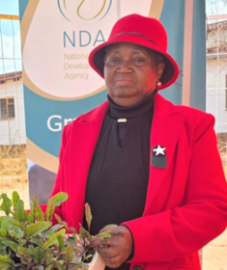
What started as one woman’s concern for children spending their afternoons unsupervised in the streets has grown into a community initiative that provides care, employment and sustainable livelihood opportunities in Maphosa village in Botlokwa, Limpopo.
Johanna Mailula, a mother of three and grandmother of two, founded the Maphosa Drop-in Centre in 2016 after witnessing school-age children spending time on the streets after school without adult supervision.
“My greatest concern was seeing children playing in the streets after school, with no one looking after them. I knew I had to do something to create a safe place where they could be cared for and supported,” Mailula recalls.
Nearly a decade later, the centre provides care and support to 68 vulnerable children, while also creating opportunities for employment, skills development, food security and sustainable livelihoods.
Mailula’s vision was shaped by the socio-economic challenges confronting families in her community, including unemployment, poverty and limited economic opportunities. Determined to make a difference, she started the centre with few resources at her disposal.
In the early years, she relied on the generosity of community members and personally went door-to-door seeking donations to keep the initiative going.
“The community supported us with the little they had, and that encouraged me to continue, despite the challenges,” she says.
Mailula’s perseverance has paid off and today, the centre provides children with psychosocial support, homework assistance, educational enrichment, life skills development and nutritious meals, helping to improve their wellbeing, while supporting vulnerable households.
However, Mailula recognised that protecting children cannot be separated from addressing the economic challenges affecting their families.
The organisation subsequently expanded into agricultural production, creating 17 permanent employment opportunities, as well as seasonal work and volunteer opportunities for community members.
The agricultural project has since become one of the centre’s flagship initiatives, producing vegetables that have attracted customers from across Limpopo.
“I am proud of how far we have come since 2016. People from different districts travel to buy our vegetables because they trust the quality of our produce,” Mailula says.
With five hectares of land allocated by the Traditional Council, she believes the project has the potential to grow into a larger and more sustainable agricultural enterprise.
“Our dream is to export our produce beyond South Africa. The additional land gives us the opportunity to increase production and build a sustainable agricultural enterprise that benefits the entire community,” she says.
Mailula’s journey also highlights the potential of community-led initiatives when supported through strategic partnerships.
The Maphosa Drop-in Centre has received support from government and development stakeholders, including the Department of Social Development, the National Lotteries Commission and the local municipality. The organisation also works with humanitarian partners, such as Gift of the Givers, to assist vulnerable households experiencing food insecurity.
A significant milestone came in 2026 when support facilitated by the National Development Agency (NDA) enabled a partnership between the Maphosa Drop-in Centre and The Church of Jesus Christ of Latter-day Saints.
Through the partnership, the organisation received R1.3 million to implement the Green Harvest Project.
The project has strengthened the centre’s agricultural capacity through the development of irrigation infrastructure, boreholes, water storage facilities, fencing and shade-net structures, as well as seedling production and crop cultivation.
It has also provided training and mentorship aimed at strengthening food production, employment creation and access to markets.
What started as a simple effort to keep children safe after school has evolved into a broader community development initiative addressing some of the pressing challenges facing rural communities, including child vulnerability, food insecurity, unemployment and limited economic opportunities.
Mailula's journey reflects the impact that locally driven leadership can have when vision is matched with action.
Through determination, community participation and strategic partnerships, Mailula has transformed a modest community initiative into a growing platform for social and economic empowerment.
Her journey demonstrates the impact that locally driven leadership can have when vision is matched with action. For Mailula, the journey is far from over.
Her ambition to expand agricultural production and ultimately access markets beyond South Africa reflects a bold vision for the future — one in which the Maphosa Drop-in Centre not only provides care and support to vulnerable children, but also becomes a sustainable economic force creating opportunities for generations to come.
Mailula is more than the founder of a drop-in centre. She has emerged as a community builder, advocate for vulnerable children and champion of sustainable livelihoods, demonstrating how community empowerment and strategic partnerships can turn a vision of hope into reality. – SAnews.gov.za


