


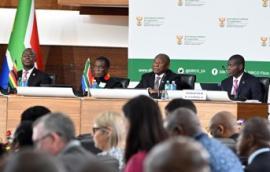
South Africa and Zimbabwe have reaffirmed their commitment to deepening bilateral cooperation, with the signing of several agreements and Memoranda of Understanding (MoUs) aimed at strengthening collaboration in key areas ranging from agriculture and gender equality to correctional services, diplomacy, arts and culture.
The agreements were signed on Friday at the conclusion of the Fourth Session of the South Africa–Zimbabwe Bi-National Commission (BNC), co-chaired by President Cyril Ramaphosa and Zimbabwean President Emmerson Mnangagwa in Pretoria.
The signing of the legal instruments formed part of efforts by the two neighbouring countries to translate the longstanding political and historical ties into practical programmes that contribute to economic growth, development and shared prosperity.
The agreements include an MoU on collaboration between the Zimbabwe Foreign Service Institute and the Diplomatic Academy of the Department of International Relations and Cooperation of South Africa. The MoU was signed by Minister Ronald Lamola and his counterpart, Minister Professor Amon Murwira, Minister of Foreign Affairs and International Trade.
An agreement on correctional services was also signed, while the two countries concluded an MoU on women's empowerment and gender equality.
Further agreements covered cooperation in agriculture, as well as arts, culture and heritage.
Closing the Fourth Session of the BNC, President Cyril Ramaphosa said the agreements represented concrete plans to deepen cooperation between the two countries.
“The agreements and Memoranda of Understanding signed in our presence today, together with the decisions reached, reflect our concrete plans to deepen cooperation. These instruments must now be implemented so that our countries and people benefit,” he said.
Strategic partnership
The President said South Africa regarded Zimbabwe as a strategic partner and one of its largest trading partners, adding that the two countries had committed to expanding investment and trade.
“For South Africa, Zimbabwe remains a strategic partner. It remains one of our largest trading partners. We have undertaken here to redouble efforts to expand investment and trade,” the President said.
He added that inclusive economic growth is critical to improving the lives of citizens by widening access to basic services and creating employment opportunities.
“Inclusive economic growth will give us the means to widen access to food, shelter, health, education, water and sanitation. It will give us the means to create employment and economic opportunities, especially for women and for the young,” he said.
Focus on investment and trade
The President identified a wide range of sectors in which he believes there are significant opportunities for closer cooperation and investment.
“We see great opportunities in agriculture and agro-processing, energy, mining, transport, medicines and vaccines, water, tourism, finance and digital technology,” he said.
He said the political commitment demonstrated at the BNC should encourage companies in both countries to invest in infrastructure and industrialisation initiatives.
The movement of people and goods between the two countries also featured prominently in the discussions, with President Ramaphosa stressing the importance of efficient border management.
“We are committed to moving people and goods seamlessly and securely across our border in a well-managed and coordinated manner,” he said.
He said Ministers and senior officials would follow up on the implementation of the priority projects identified during the BNC.
The two countries also committed to strengthening cooperation in addressing cross-border and transnational organised crime, while deepening people-to-people and cultural relations.
South Africa and Zimbabwe would also continue working with other SADC countries to advance regional integration and industrialisation.
“Our common history and geography are the foundations of our shared future. The realisation of that shared future depends on effective and sustained collaboration,” he said.
He urged both countries to ensure that the decisions taken at the BNC translate into tangible improvements in the lives of their people.
“As we prepare for the Fifth Session of our Bi-National Commission, let us turn our decisions into actions. Let us turn our people’s expectations into reality,” he said.
Zimbabwe seeks stronger economic integration
President Mnangagwa welcomed the outcomes of the BNC, describing the session as highly productive and one which had set key priorities and the strategic direction for the bilateral relationship.
He said the relationship between South Africa and Zimbabwe was rooted in shared history, solidarity and common values, adding that the prosperity of one country is closely linked to that of the other.
“When South Africa thrives, Zimbabwe thrives too, and vice versa,” President Mnangagwa said.
He said the two countries had agreed to reduce their over-reliance on distant markets.
“We agreed to reduce over-reliance on distant markets as a way to build resilience from external shocks,” he said.
President Mnangagwa identified cross-border manufacturing value chains, infrastructure development, agriculture and mineral beneficiation among the High Impact Priority Projects that should now be implemented.
“We should implement the identified High Impact Priority Projects, which include cross-border manufacturing value chains, infrastructure development projects and agriculture, as well as mineral beneficiation, among other strategic and transformational economic projects,” he said.
He also placed particular emphasis on infrastructure that would improve the movement of people, goods and services.
“The construction of the Third Limpopo Bridge and operationalisation of the One Stop Border Post are priorities that are vital in facilitating seamless movement of goods, services and people across our borders,” he said.
In this regard, President Mnangagwa said Zimbabwe was committed to removing barriers to trade and addressing challenges experienced by South African businesses operating in Zimbabwe.
“In this respect, Zimbabwe is committed to removing all the tariff and non-tariff barriers to trade. We are also ready to resolve the challenges faced by South African entities operating in Zimbabwe,” he said.
He reaffirmed Zimbabwe's drive to improve the business environment and attract cross-border investment.
Shared heritage
Beyond economic cooperation, the BNC also placed emphasis on preserving the shared liberation history of the two countries.
President Mnangagwa called on South Africa to develop land allocated to it at the Museum of African Liberation in Zimbabwe, saying the initiative would help preserve the history of the struggle against apartheid and inspire future generations.
“Your Excellency, Zimbabwe looks forward to South Africa taking steps to develop land allocated to it at the Museum of African Liberation.
“The Museum provides a unique platform to showcase the country's heroic anti-apartheid struggle, and its significant contribution to the liberation of the African countries,” he said.
The President also expressed appreciation for South Africa's support for Zimbabwe's election as a non-permanent member of the United Nations Security Council and for its advocacy for the removal of sanctions imposed on Zimbabwe.
Implementation
Looking ahead, President Mnangagwa said the signing of the agreements was only the beginning, and that the two governments now needed to ensure that commitments were implemented.
“Today, we have adopted important decisions and witnessed the signing of several legal instruments in various fields of cooperation.
“We must now translate these commitments into tangible outcomes through concrete actions that deliver meaningful benefits for our countries and people,” he said.
He called for the full use of the Decision Management System to monitor implementation and identify areas requiring corrective action.
President Mnangagwa said he was confident that the outcomes of the Fourth BNC would contribute to the development objectives shared by the two countries.
“I am confident that the win-win outcomes of this BNC will contribute significantly to our shared developmental agenda,” he said.
The Fourth Session of the BNC has therefore set out an expanded programme of cooperation between South Africa and Zimbabwe, with both governments now expected to focus on implementation, particularly in trade, investment, infrastructure, agriculture, energy, mining, border management and people-to-people relations.
The two Presidents agreed that the strength of the bilateral relationship would ultimately be measured not only by the agreements signed, but by the extent to which those commitments translate into economic opportunities and tangible benefits for the people of both countries. – SAnews.gov.za


