


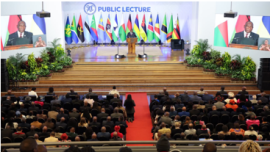
President Cyril Ramaphosa has called on Southern African Development Community (SADC) Member States to use the region’s abundant mineral, agricultural, energy and human resources to drive its own industrial revolution and reduce dependence on external markets.
Addressing a Public Lecture at the University of KwaZulu-Natal (UKZN), Westville Campus, on Friday, President Ramaphosa said SADC has the resources, markets and institutions needed to build a prosperous and industrialised region but needs to work with greater urgency to turn this potential into reality.
The Public Lecture, held on the eve of the 46th SADC Summit in Durban, was convened under the theme: “Translating SADC Vision 2050 into Action: Pathways Towards Solidarity, Equality and Shared Prosperity.”
President Ramaphosa said the region’s continued reliance on external markets has exposed its economies to global disruptions and undermined its ability to realise the full benefits of its resources.
“Trade among SADC states stands at just under a quarter of our combined total trade. And yet together, we have the means to produce all the goods and services that we need. Together, as a community, we have all the energy sources we need. We have the land and the means to produce all the food we need.
“Together, we have the mineral resources we need. We have the technology and know-how to turn these resources into the manufactured goods that our people use. We have the financial institutions, the funding instruments and the markets to finance our industries and to build the infrastructure we need.
“And yet we look beyond our shores to supply our people,” the President said.
The region’s colonial-era infrastructure and economic systems had contributed to this dependence, with railways historically designed to transport raw materials to ports rather than connect African economies.
He said the current global economic environment has made the need for greater regional self-reliance even more urgent, with conflicts and disruptions far beyond the region affecting shipping, agricultural markets, fertiliser supplies, grain prices and the cost of living.
“These global developments teach us that access to a distant market, however valuable, is a borrowed advantage. This access may be extended, and it may be withdrawn. Decisions are often taken in capitals far away, where our businesses have no say, and our workers have no vote.”
He added that a regional market is advantageous and that “others cannot take it away from us.” In addition, the welfare, sovereignty and security of SADC countries require the region to build a more integrated market in which the benefits of trade are evenly distributed.
He also called for the development of an industrial model suited to the region’s own circumstances.
“This region holds a substantial share of the world’s critical mineral resources. Many of the materials upon which the energy transition of the entire planet depends lie beneath our soil.
“We supply an industrial revolution taking place somewhere else, and we then purchase its products at a price set by others. We need to use our own resources to drive our own industrial revolution."
He said the region’s ambition should not simply be to catch up with other economies, but to build an economy suited to its own resources and circumstances.
Turning commitments into investment
President Ramaphosa called for the removal of non-tariff barriers, harmonisation of standards and more efficient border processes to support regional trade.
“Suppliers should no longer have to wait months for a licence. Goods should no longer have to be inspected on one side of the border and then again on the other. Standards should be harmonised, transparent and applied consistently.”
He also called for the commitments made through the SADC Industrialisation Week to be translated into investment in local processing of critical minerals and agricultural products.
“We must turn that commitment into refining and smelting capacity. We must turn our intentions into investments – investments in regional electricity generation and transmission, investments in cross-border water schemes.”
He further called for investment in roads, rail lines and ports so that processed minerals and manufactured goods can be moved around the region. He added that the SADC Regional Development Fund should be used to mobilise resources for industrialisation and infrastructure.
He further warned that the region is losing significant resources through illicit financial flows, including transfer mispricing, under-declared exports and smuggling.
Regional industrialisation
President Ramaphosa identified pharmaceuticals, automotive manufacturing, agro-processing, paper and pulp, furniture, innovation and semiconductor value chains as areas with potential to drive regional industrialisation.
He placed particular emphasis on pharmaceuticals and called for greater health sovereignty.
“We can no longer accept that we import almost everything that heals us. Our answer must be health sovereignty, pursued in line with the Lusaka Agenda on global health initiatives,” he said.
He welcomed the establishment of a SADC pooled procurement mechanism, saying joint purchasing could provide manufacturers with the market certainty required to invest in production capacity within the region.
“When we purchase together, we create the market certainty that manufacturers in our region need before they will invest. That certainty does two things at once. It secures equitable access to medicines and health commodities for our people. And it creates jobs, cultivates expertise and stimulates industrial activity here at home,” he said.
President Ramaphosa also called for integrated infrastructure, with regional transport corridors such as the Maputo, North-South, Trans-Kalahari, Beira and Lobito corridors serving as broader platforms for trade, investment and industrial development.
“These corridors must carry power, data and people,” he said.
On energy, he highlighted planned interconnectors and greater power trading through the Southern African Power Pool, as well as the expansion of electricity access through mini-grids and off-grid solutions.
He also called for investment in renewable energy, green hydrogen and battery storage.
Digital economy, agriculture
President Ramaphosa warned that SADC could reproduce old patterns of economic dependency in the digital economy if it continued to export data and import processed intelligence.
He called for greater investment in computing capacity, connectivity and skills, among others.
“If we are serious about industrialisation, we cannot stop at refineries and smelters. We need to develop the computing capacity, connectivity and appropriate skills to ensure that the value of our data is extracted here at source,” he said.
He also called for the modernisation of agriculture, including investment in irrigation, climate-resilient seeds, veterinary science and agro-processing. This, he said, can create employment in small towns and villages.
President Ramaphosa said small and medium-sized enterprises would be central to the region’s industrial transformation, particularly in creating opportunities for women and young people.
“Southern Africa’s industrial revolution will ultimately not be driven by the large conglomerates listed on stock exchanges, but by the tens of thousands of small and medium-sized businesses that bring innovation, agility and competitiveness to the economy,” he said.
President Ramaphosa said the transformation envisaged under Vision 2050 requires the region to move beyond exporting raw materials and become a producer of higher-value goods and services. – SAnews.gov.za


