


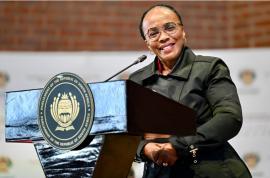
Minister in the Presidency for Women, Youth and Persons with Disabilities Sindisiwe Chikunga has called for deliberate and accelerated action to advance gender justice, equality, women’s economic empowerment and skills development.
Speaking at the National Women’s Day Commemoration at Sol Plaatje University in Kimberley, Northern Cape, on Thursday, Chikunga said women must be placed at the centre of efforts to build resilient and inclusive economies.
The event, hosted by Parliament under the theme: "70 Years of Resistance, 72 Years of Vision – Advancing Gender Justice, Equality and Resilient Economies for All", reflected on the progress made by women, while highlighting the work that remains.
The event comes as South Africa undertakes its Milestones of Freedom campaign, which is a year-long programme launched by President Cyril Ramaphosa on 18 June 2026. Held under the theme: "Honouring the Past. Delivering the Future", the initiative commemorates pivotal historical anniversaries in the nation's journey to democracy, while driving community service delivery and social cohesion.
Delivering a message of support at Thursday's event, Chikunga reflected on the gains made since the adoption of the Women’s Charter in 1954 and the historic 1956 Women’s March to the Union Buildings in protest of apartheid pass laws.
She noted that many of the rights women fought for are now protected in law, with women currently making up 43.5% of the National Assembly and 45% of judges.
More than 60% of university graduates are women, while women have received 58% of the nearly 3.4 million housing subsidies approved since 1994.
“Every one of these victories was fought for by women, whose names may never reach the spotlight. Let us celebrate the domestic worker, who is now protected by law; the farm worker, who now has a minimum wage, and the girl in Galeshewe, who will finish matric this year, in a country where in 1996, less than 16% of women had done so,” Chikunga said.
She also used the occasion to highlight how access to education and opportunities has changed the lives of young women.
“Let us celebrate that this commemoration is hosted at a university carrying the name of Sol Plaatje, in a province where a young woman can now study astronomy and work at the largest radio telescope on earth for free through the National Students Financial Aid Scheme (NSFAS),” she said.
However, Chikunga cautioned that significant structural barriers remain and that legal equality has not always translated into economic ownership and control.
“Women’s relationship to land, property and related productive assets still demands our urgent attention because the law changed and the ownership did not. Our approach to building resilient economies cannot ignore the disproportionate burden women continue to carry on behalf of everyone,” she said.
The Minister said that while the necessary laws are in place, government must accelerate funded reform programmes to ensure women have meaningful access to productive assets.
She also highlighted the disproportionate burden of unpaid care work carried by women, saying government is developing a care economy strategy to ensure that work sustaining households and communities is recognised, supported and paid.
“When a clinic closes, a woman nurses the sick at home. When a creche closes, a woman stays home. The legacy of those decisions is still carried on the backs of African women, and reversing it will take deliberate law, deliberate policy and most of all, deliberate action,” Chikunga said.
She stressed that building resilient economies requires policies that recognise and respond to the realities women face.
Structured and sustained mentorship
Chikunga identified structured and sustained mentorship for young women as another key priority, saying mentorship must move beyond one-off career days and create deliberate pathways into industries, leadership positions and decision-making spaces.
In the mining sector, she called for young women to be mentored across the entire value chain, including geology and exploration, mine engineering, processing and beneficiation, rehabilitation and corporate leadership.
She also called for greater mentorship opportunities for women in logistics, energy security and Parliament, saying young women must be prepared to occupy positions where decisions affecting the country's future are made.
Chikunga further highlighted the Northern Cape’s enormous potential in renewable energy, noting that the province has the largest concentration of solar and wind generation in South Africa.
She said young women from areas such as Upington, De Aar and Springbok should be actively included in the growth of the sector rather than watching developments from the sidelines.
For Chikunga, advancing gender equality is not only about celebrating how far women have come, but ensuring that the next generation has a meaningful stake in the country’s economic future. – SAnews.gov.za


