


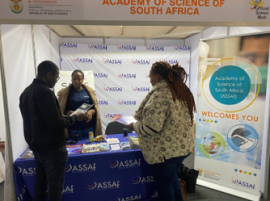
With the inaugural National Science Month drawing to a close, the Academy of Science of South Africa (ASSAf) is calling on citizens to hold on to their curiosity about science beyond July.
“Science has the power to transform lives, spark curiosity, and create solutions to society's greatest challenges,” communication officer at the Academy, Henriette Wagener, told SAnews.
The Academy of Science of South Africa is the country’s official national academy of science. It was inaugurated in 1996 by former President Nelson Mandela and exists to use science for the benefit of society.
ASSAf mobilises South Africa’s leading scholars across all fields to provide independent, evidence-based advice; promote excellence; support scholarly publishing; strengthen public understanding of science; and connect South African science to the world.
National Science Month was born from the transition from National Science Week, which has been observed since 2000, to a month-long commemoration in July, reflecting government's recognition of the increasingly important role of science, technology and innovation in addressing complex global and national challenges.
“Globally, science is advancing rapidly, particularly in areas such as artificial intelligence (AI), health, climate change, energy, space science and digital technologies. At the same time, the world faces growing pressure to ensure that science is ethical, inclusive and trusted. South Africa has excellent scientists, strong institutions and world-class capabilities, but we remain under-invested. South Africa spends about 0.61% of GDP (gross domestic product) on R&D (research and development]),” she said.
The 2023 Science, Technology, and Innovation Indicators (STI) Report published by the National Advisory Council on Innovation (NACI), which is an agency of the Department of Science, Technology, and Innovation, states that gross expenditure on research and development as a percentage of GDP declined from 0.76% in 2017/18 to 0.61% in 2020/21.
She added that South Africa’s share of science, technology, engineering and mathematics (STEM) graduates remains below the Organisation for Economic Cooperation and Development (OECD) average. The OECD, of which South Africa has been a key partner since 2007, is a global policy forum that promotes policies to preserve individual liberty and improve the economic and social well-being of people around the world.
The OECD’s Education at a Glance 2025: South Africa country note states that across the OECD, the two most popular broad fields of study are science, technology, engineering, mathematics, business, administration and law - each accounting for 23% of graduates from bachelor’s or equivalent programmes.
These are closely followed by the broad fields of arts and humanities, social sciences, journalism and information, which account for 22% of graduates.
“In South Africa, 15% of bachelor’s degree students graduate from a STEM field; 38% from business, administration, and law, and 16% from arts and humanities, social sciences, journalism, and information,” it noted.
Wagener added that South Africa must strengthen “the school-to-university pipeline, especially in mathematics, science, and digital skills.”
However, she added that young people are interested in the study of the sciences, with interest being shown in fields such as artificial intelligence (AI), data science, robotics, health sciences, biotechnology, environmental science, climate change, engineering, space science, and renewable energy.
In addition, citizens should not be afraid of AI, as it can help with learning, translation, research, administration, healthcare, agriculture, business, and public services. However, AI also raises concerns around privacy, bias, misinformation, jobs, and accountability.
“The best response is not fear, but responsible use: understand the tools, check information carefully, protect personal data, and insist that AI serves people and society,” she said.
Bringing science closer to communities
Wagener added that the observation of the annual National Science Month (NSM) is a good move for the country.
“It places science, technology and innovation closer to communities, schools, industry, and citizens and affirms the theme that ‘Science, Technology, and Innovation Are for Everyone.’ For ASSAf, this is directly aligned with our mandate to promote public interest in science and science education. Science has the power to transform lives, spark curiosity, and create solutions to society's greatest challenges,” she explained.
In its participation in the month-long initiative, the academy has engaged communities across Gauteng, Mpumalanga, and the North West provinces through interactive talks, science demonstrations, exhibitions and career engagement activities.
“By connecting communities with leading scientists and inspiring young people to explore careers in STEM, ASSAf is fostering a culture of curiosity, innovation, and evidence-based thinking. National Science Month is a celebration of the power of science to improve lives, empower communities, and build a more sustainable future for South Africa.”
Wagener is of the view that NSM can make a difference in perceptions about science.
“Science Month can help citizens see that science is not remote or elitist; it is part of everyday life - from clean water, public health, and food security to weather forecasting; technology; transport; and education. Its real impact will depend on sustained engagement in all provinces, in local languages, and with communities that do not always see themselves reflected in science.”
Inclusivity and trust
Building a stronger and more inclusive science system is among the most pressing challenges facing science today.
“The most pressing challenge is building a much stronger and more inclusive science system. This means improving mathematics and science education, investing more in research and development, supporting young researchers, retaining talent, maintaining research infrastructure, and ensuring that scientific evidence informs public policy.
“We need science to address poverty, unemployment, inequality, climate change, health, energy, and food security,” she said.
Building and maintaining trust is another challenge facing the sector.
“One of the most pressing challenges facing science in South Africa is building and maintaining public trust. Scientific research can only have a meaningful impact if people understand, value, and trust scientific evidence.
“Misinformation, limited science communication, and unequal access to quality science education can make it difficult for communities to engage with science or apply scientific findings in their daily lives.
Strengthening public trust requires scientists, policymakers, educators, and the media to communicate research clearly, involve communities in scientific discussions, and demonstrate how science improves people's lives,” she said.
Improving lives
And yes, there is more to scientists than just lab coats.
“They are citizens too - parents, teachers, mentors, innovators, and problem-solvers. They do not claim to have all the answers, but they are trained to ask careful questions, test evidence, admit uncertainty, and revise conclusions when better evidence emerges. Science is not about arrogance; it is about curiosity, evidence, and service. Scientists are ordinary people dedicated to solving extraordinary challenges.”
Wagener said scientists are driven by curiosity and a desire to improve lives by addressing some of the world's most pressing issues, such as water scarcity, climate change, food security, disease outbreaks, energy sustainability, and biodiversity loss.
“While scientists may work in laboratories, in the field, or behind computers, their work is ultimately about finding practical solutions that benefit society. Like everyone else, they face challenges, learn from setbacks, and collaborate with others to make discoveries. By understanding that scientists are people working for the public good, citizens can build greater trust in science and appreciate its role in improving everyday life.”
The future
ASSAf said the future of science will be more collaborative, interdisciplinary, and connected to society.
“The major challenges of our time cannot be solved by one discipline or one country alone. Our message to citizens is that science belongs to you. Ask questions, seek evidence, encourage young people to explore science, and help build a society where knowledge is trusted, shared, and used for the public good.
“The future of science depends on our ability to make science accessible and relevant to society. Scientific discoveries should not remain confined to laboratories or academic journals."
Wagener added that these scientific discoveries need to be communicated in ways that people can understand and apply in their daily lives. -SAnews.gov.za


