


Water and Sanitation Deputy Minister, Dr Jack Bloom, has called on South Africans to play an active role in protecting and restoring the country's water resources.
Bloom made the call during the launch at the 2026 Clear Rivers Campaign at the Apies River in Pretoria North on Monday.
The campaign forms part of the Department of Water and Sanitation's ongoing commitment to restore South Africa's rivers, protect the country’s scarce freshwater resources and strengthen water security for current and future generations.
Held during Mandela Month, under the theme: "South Africa is a water-scarce country Clean up and protect our water resources", the campaign brought together representatives from national, provincial and local government, State-owned entities, environmental organisations, schools, the private sector, community-based organisations, and volunteers in a united effort to rehabilitate one of Gauteng's most polluted rivers.
The launch also forms part of the department's nationwide initiative encouraging citizens to dedicate their 67 minutes of service to cleaning rivers, wetlands, streams, canals, dams, and other freshwater ecosystems while promoting environmental stewardship, and responsible water resource management.
Delivering the keynote address, Bloom said the campaign aims to strengthen environmental awareness, encourage volunteerism and inspire active citizen participation in protecting South Africa's limited freshwater resources.
"Our rivers are the lifeblood of our communities, our economy and our ecosystems. Their protection cannot be left to government alone. Every South African has a responsibility to prevent pollution, report illegal dumping and become an active custodian of our water resources," Bloom said.
Bloom emphasised that while community clean-up campaigns play an important role in restoring rivers, he warned that they address only the visible effects of pollution. Sustainable improvements, he said, require tackling the root causes, including illegal dumping, deteriorating wastewater infrastructure and the discharge of untreated sewage into rivers.
Referring to the Apies River, the Deputy Minister said years of sewage spills, industrial pollution and urban waste have severely degraded the river, making it unsafe for human contact while threatening biodiversity, livelihoods, and surrounding ecosystems.
Bloom also highlighted findings from the 2025 Green Drop Report, which revealed that nearly half of South Africa's municipal wastewater treatment systems are in a critical state.
To strengthen accountability and improve compliance, he said the department is establishing a National Polluters Register to identify polluters and ensure they are held accountable for contaminating the country's water resources.
Earlier, Acting Deputy Director-General for Water Resources Management, Dr Moloko Matlala, described the Apies River as a historically significant water resource that continues to support communities, biodiversity, and local livelihoods.
Matlala encouraged communities to participate in the department's Adopt-a-River Programme, which enables citizens to monitor river health through citizen science initiatives, such as the mini Stream Assessment Scoring System (miniSASS), while promoting community ownership and sustainable river management.
He also acknowledged the work of the Environmental Warriors, led by citizen scientist Noloyiso Mbiza, whose volunteers have been conducting regular clean-up activities along the Apies River since 2023.
Representatives from Plastics SA, Rand Water, the Trans-Caledon Tunnel Authority (TCTA), the City of Tshwane and other environmental partners, reaffirmed their commitment to strengthening collaboration on river conservation, environmental education, and responsible waste management.
One of the highlights of the event was an address by a nine-year-old learner from Laerskool Akasia, representing the Environmental Warriors, who encouraged young people to become environmental ambassadors and reminded participants that protecting rivers begins with individual responsibility.
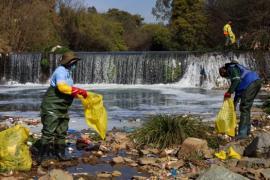
Following the launch, the Deputy Minister, government officials, community members, youth volunteers, and environmental partners participated in a clean-up operation, removing litter and debris from the riverbanks, a low-water bridge and sections of the river channel.
The department expressed sincere appreciation to all stakeholders, including the City of Tshwane, Rand Water, Plastics SA, the Wildlife and Environment Society of South Africa (WESSA), Coca-Cola Beverages South Africa, the Trans-Caledon Tunnel Authority, schools, community organisations, and volunteers for supporting the campaign.
It reiterated its call on communities, businesses, schools, and civil society organisations to adopt rivers in their local areas, report pollution, participate in regular clean-up campaigns and promote responsible environmental practices throughout the year. – SAnews.gov.za


