


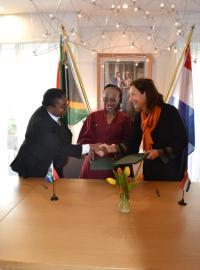
The success of the newly signed cooperation agreement between South Africa and the Kingdom of the Netherlands will ultimately be measured by the positive impact it has on the lives of women, young people and persons with disabilities.
Deputy Minister in the Presidency for Women, Youth and Persons with Disabilities Mmapaseka Letsike made the remarks after South Africa and the Netherlands signed a Memorandum of Understanding (MoU) aimed at strengthening cooperation on the empowerment of women, youth and persons with disabilities.
The agreement was signed on Monday during a bilateral engagement between Minister in the Presidency for Women, Youth and Persons with Disabilities Sindisiwe Lydia Chikunga and the Netherlands' Ambassador to South Africa, Joanne Doornewaard.
The MoU provides a framework for cooperation in areas including gender equality, youth development, disability inclusion and the promotion of human rights.
Delivering the closing remarks at the signing ceremony, Letsike said the agreement marks the beginning of a partnership that must deliver tangible results through effective implementation.
"The significance of today will not be determined by how carefully the document is worded; how warmly we speak of friendship, or even by the ceremony we have just witnessed. It will be determined by what changes after we leave this room," Letsike said.
The Deputy Minister said the agreement provides for the establishment of a bilateral working group under the South Africa-Netherlands Joint Commission for Cooperation. The body will be tasked with developing a two-year implementation plan, monitoring progress and submitting annual reports on the partnership's outcomes.
She emphasised that implementation should be guided by clear timelines, defined responsibilities and measurable targets to ensure the agreement delivers meaningful benefits.
Letsike also called for the active involvement of civil society organisations, youth formations, organisations representing persons with disabilities, LGBTI+ groups, researchers and frontline practitioners in implementing and reviewing the agreement.
She said both countries stand to benefit from sharing knowledge and experience, while acknowledging that South Africa and the Netherlands continue to face challenges in advancing equality and inclusion.
"Neither South Africa nor the Netherlands arrives in this partnership as a completed project. Both countries bring experience, institutions and lessons, but both also have inequalities and blind spots that require continued democratic work," she said.
Letsike stressed that disability inclusion initiatives should be shaped by persons with disabilities and their representative organisations, in line with the principle of "Nothing About Us Without Us".
She added that the cooperation framework will also strengthen efforts to protect human rights and democratic values at a time when progressive rights face growing challenges globally.
The Deputy Minister is expected to build on the new partnership during her upcoming visit to Amsterdam for WorldPride, where she plans to engage Dutch government counterparts on priority areas for implementation.
She said discussions with the Netherlands' Ministry of Foreign Affairs and the Ministry of Health, Welfare and Sport could help identify immediate priorities, connect implementation teams and maintain the momentum created by the signing of the agreement. – SAnews.gov.za


