


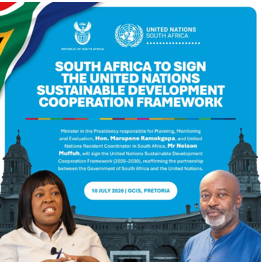
Minister in the Presidency responsible for Planning, Monitoring and Evaluation, Maropene Ramokgopa, says the signing of the United Nations Sustainable Development Cooperation Framework (UNSDCF) reaffirms South Africa and the United Nations' shared commitment to building a more inclusive, prosperous, resilient and just society.
Speaking at the signing ceremony in Pretoria on Friday, Ramokgopa said the agreement marks the beginning of a new phase of cooperation focused on delivering measurable improvements in the lives of South Africans.
"Your involvement shows that sustainable development cannot be achieved by government alone. It needs collective leadership, shared responsibility and lasting partnerships," she said.
The Minister thanked government departments, provincial and local governments, organised business, organised labour, civil society, academia and development partners for their contributions to developing the framework.
"Today's ceremony marks an important transition. The signing of the Cooperation Framework confirms our shared vision. It represents something even more significant: our collective readiness to shift from planning to action, from commitments to measurable outcomes, and from aspirations to real improvements in the lives of our people," Ramokgopa said.
She said the Department of Planning, Monitoring and Evaluation (DPME) places great importance on ensuring that international cooperation supports South Africa's national development goals, strengthens institutions and delivers better outcomes for citizens.
Ramokgopa noted that the framework comes at a pivotal time in the country's development journey, following the adoption of the Government of National Unity's Medium-Term Development Plan (2024–2029).
"The Plan focuses on faster and more inclusive economic growth, sustainable job creation, poverty reduction, improved public service delivery, infrastructure development, energy security, strong institutions, and a developmental state that puts citizens at the centre of governance," she said.
She added that government's ongoing programme of structural reforms, including Operation Vulindlela, infrastructure investment, improvements in the energy and logistics sectors, and efforts to create a more competitive economy, is aimed at unlocking South Africa's long-term growth potential.
"Achieving these reforms requires capable institutions, technical expertise and strategic partnerships. The United Nations is a key partner in this journey."
Ramokgopa said the Cooperation Framework has been deliberately aligned with South Africa's national planning framework.
"This alignment reflects a principle that South Africa has consistently supported – that development cooperation must be nationally owned, country-led and aligned with domestic priorities rather than dictated by external agendas."
She explained that the framework will serve as the primary platform through which the UN Development System will support South Africa over the next five years through policy advice, technical assistance, innovation, institutional strengthening, knowledge sharing and strategic partnerships.
The framework also reinforces South Africa's commitment to the 2030 Agenda for Sustainable Development and the African Union's Agenda 2063.
"As we strive to achieve the Sustainable Development Goals, we understand that our national priorities and our global commitments reinforce one another," she said.
Ramokgopa stressed that the success of the framework will ultimately be measured by its impact on people's lives.
"It will be measured by whether young people find meaningful work, whether communities gain access to reliable public services, whether women and vulnerable groups have better economic opportunities, whether institutions become more capable, ethical and responsive, whether inequality decreases and poverty declines, and ultimately whether the quality of life for all South Africans improves.
"This demands disciplined implementation. It needs evidence-based policymaking. It requires stronger monitoring and evaluation. It requires accountability, and most importantly, it requires partnership."
In his opening remarks, United Nations Resident Coordinator Nelson Muffuh said the signing represents more than a formal agreement.
"It reaffirms a deeper commitment that the decisions we take, the partnerships we build and the resources we mobilise translate into real improvements in people's lives.
"This means that our commitments must be felt in homes, schools, workplaces and communities, and in the opportunities available to every child."
Muffuh described the Cooperation Framework as "a programme of action" that will guide collaboration with greater focus, discipline and urgency as the world enters the final stretch towards achieving the Sustainable Development Goals by 2030.
He noted that while progress has been made globally, it remains too slow.
"Only 36% of measurable targets are on track or making moderate progress, nearly half are advancing too slowly, and others have regressed since 2015.
"The message from New York is clear: the Sustainable Development Goals continue to work where political will, sustained investment and cooperation come together, but they are not moving fast enough, evenly enough or inclusively enough," Muffuh said.
The signing ceremony marks the start of a five-year partnership between South Africa and the United Nations to support the country's national development priorities and accelerate progress towards the Sustainable Development Goals.
Covering the period from 2026 to 2030, the Cooperation Framework sets out the strategic direction for collaboration between government and the UN system, reaffirming a shared commitment to inclusive economic growth, reducing inequality, strengthening institutions, protecting the environment and ensuring that no one is left behind.
Among those attending the ceremony were Health Minister Dr Aaron Motsoaledi, senior representatives from national government, civil society organisations, foundations, members of the diplomatic corps, United Nations entities and development partners. – SAnews.gov.za


