


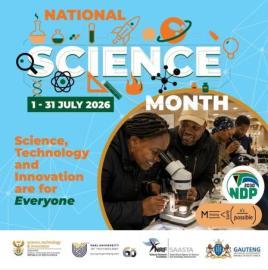
South Africa will mark National Science Month (NSM) throughout July with a nationwide programme aimed at promoting scientific literacy, innovation and public engagement in science, technology and innovation (STI).
The month-long campaign will officially launch on 4 July 2026 at the Vaal University of Technology Southern Gauteng Science and Technology Park in Sebokeng under the theme, "Science, Technology and Innovation are for everyone”.
Led by the Department of Science and Innovation (DSI) and implemented through the National Research Foundation's South African Agency for Science and Technology Advancement (SAASTA), National Science Month seeks to build a society that is informed about science and able to engage critically with scientific and technological developments.
This year's launch coincides with Nelson Mandela Month and will honour the legacy of former President Nelson Mandela by highlighting his contribution to democracy through science-focused activities and community engagement.
The initiative provides an opportunity for scientists, educators, innovators, research institutions and communities to showcase how science and technology are improving lives, transforming communities and addressing some of the country's most pressing challenges.
Since its introduction in 2000, National Science Month has encouraged voluntary participation from South Africans while providing a platform to showcase grassroots innovation, scientific research and technological advances.
The initiative also aims to strengthen South Africa's reputation as a nation of scientific discovery and innovation.
A key focus of this year's programme is inspiring young people to pursue careers in science, technology, engineering and innovation.
Schools are encouraged to participate in science competitions and activities, including discussions on emerging technologies such as artificial intelligence, while initiatives like the Eskom Expo for Young Scientists continue to nurture the country's next generation of researchers and innovators.
Increasing youth participation in science-related fields is essential to supporting South Africa's future economic growth and global competitiveness.
South Africa's research sector continues to strengthen its international standing. In 2023, the country produced 25 775 scientific publications, ranking 29th globally and second in Africa.
South African research continues to have significant international influence, particularly in health sciences, the humanities and the natural sciences.
The country has also made notable advances in agricultural innovation, with applications for plant breeders' rights increasing from 263 in 2022 to 318 in 2023, placing South Africa among the world's leading countries in this field.
Investment in health research has also grown significantly, more than doubling from R4.7 billion in 2013/14 to R10 billion in 2022/23.
Health research now accounts for nearly a quarter of South Africa's total research and development expenditure, reflecting the country's commitment to improving healthcare through innovation.
South Africa is also expanding its presence in the space sector, having launched nine objects into space during 2023. Universities, including the Cape Peninsula University of Technology, continue to develop critical skills through programmes such as nanosatellite development, supporting the growth of the country's future space industry.
Throughout July, National Science Month activities will demonstrate how science contributes to everyday life, from improving access to clean water and advancing healthcare to addressing climate change and creating new economic opportunities.
Government has called on all South Africans to participate in National Science Month activities and discover how science, technology and innovation can help shape a more prosperous, inclusive and sustainable future. – SAnews.gov.za


