


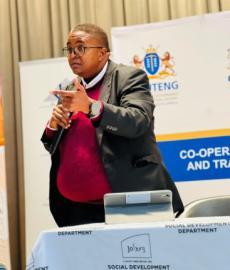
Deputy Minister in the Presidency for Women, Youth and Persons with Disabilities Mmapaseka Steve Letsike, has warned that development cannot be considered genuine progress if it results in unsafe, inaccessible, and unequal spaces.
Letsike made the remarks while addressing the Institute of Building Inspectors Youth Sector Business Breakfast at the Brixton Multipurpose Centre in Johannesburg.
Letsike called for a human rights-centred approach to infrastructure development, arguing that the built environment plays a critical role in advancing dignity, equality, and constitutional rights.
"A human rights approach to the built environment begins with the simple truth that development is not development if it produces unsafe, inaccessible and unequal spaces," Letsike said on Thursday.
She said South Africa's democratic project should be measured not only through laws and policies, but through the quality and accessibility of homes, schools, clinics and public spaces experienced by citizens every day.
"The right to housing is not meaningful if the house is structurally defective. The right to education is weakened if the school is unsafe or inaccessible. The right to health is compromised if the clinic cannot be reached or used by persons with disabilities.”
Letsike said the work of building inspectors and other built environment professionals must be understood as human rights work.
" You are not simply checking walls, roofs, foundations, fire safety, drainage, accessibility, and compliance. When you do this work, you are not only inspecting a structure; you are carrying a public trust.
“You are the person who helps ensure that poor workmanship does not become a family’s financial ruin, that weak oversight does not become tomorrow’s tragedy, and that the promise of development is not betrayed by unsafe construction. In many ways, you stand at that critical point where regulation meets real life, where a technical decision can protect a worker, a homeowner, a child, a tenant, and an entire community from harm," the Deputy Minister explained.
She further warned that weak inspection systems can have devastating consequences, including collapsed buildings, unsafe workplaces, defective housing, wasted public resources and declining public confidence in government institutions.
According to Letsike, every structure and public space communicates who is valued and protected in society.
"The built environment is never neutral because every structure we raise and every space, we design carries a message about who matters, who belongs and who is protected," she said.
The Deputy Minister linked the discussion to South Africa's constitutional journey, noting that the country is commemorating 30 years of the Constitution, 50 years since the 1976 Soweto Uprising and 70 years since the 1956 Women's March.
These milestones, she said, should serve as a reminder that the struggle for dignity and inclusion continues in modern forms, including access to safe infrastructure and economic opportunity.
She further called for greater transformation within the built-environment sector, highlighting the continued underrepresentation of women, young people, persons with disabilities and professionals from township and rural communities.
In addition, municipalities, professional bodies, training institutions and the private sector were urged to work together to create clearer pathways into professional practice, strengthen mentorship programmes and ensure that professional registration processes remain rigorous but accessible.
"A building inspector who refuses to sign off unsafe work is defending the Constitution. A municipality that strengthens inspection capacity is defending the Constitution. A developer that respects standards and trains young professionals is defending the Constitution," the Deputy Minister said. – SAnews.gov.za


