


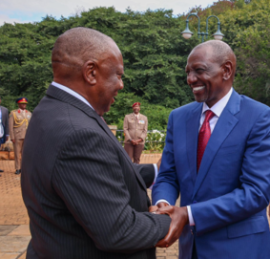
South Africa and Kenya have rejected the notion that Africa is merely a spectator in a rapidly changing global order, with Presidents Cyril Ramaphosa and William Ruto asserting that the continent is increasingly shaping global debates on governance, finance, development and peace.
Responding to questions from journalists at a media briefing following their bilateral talks at the Union Buildings on Thursday, the two leaders outlined how Pretoria and Nairobi are working together to advance African interests amid growing geopolitical competition and shifting global power dynamics.
President Ramaphosa said while South Africa and Kenya do not see themselves as superior to other African nations, both countries possess influence that can be used to advance continental priorities.
“As President Ruto said, the two countries, Kenya and South Africa, obviously do not want to overplay our status and importance... on the African continent. All countries on our continent are equal, but our two countries do have an elevated voice and are able to bring about influence that is quite often able to shape things and to move things not only on our continent, but also at a global level,” President Ramaphosa said.
The President stressed that relations between South Africa and Kenya are based on partnership rather than competition.
“We are not rivals. South Africa and Kenya never see ourselves as rivals. We are complementary, and we have our own special strategic relationship that speaks to friendship, that speaks to respect, and that speaks to equality between our two nations,” he said.
The President said the two countries consistently find common ground on continental and international issues, and have strengthened cooperation through institutions such as the African Union.
“We always find that we are so well aligned on many issues, both in dealing with national issues, as well as in dealing with continental matters and global matters,” he said.
The President pointed to ongoing collaboration in conflict resolution efforts across Africa, citing the role both countries have played in peace initiatives in the eastern Democratic Republic of Congo, Sudan and South Sudan.
“Our work is based on cooperation. We cooperate well together, and we are able to come up with initiatives that are aligned, that are aimed at resolving problems on a peaceful basis, and that are aimed at advancing the interests not only of our two countries but also of other countries - sister countries on our continent,” President Ramaphosa said.
Africa shaping global discourse
President Ruto said Africa is increasingly moving from the margins of global decision-making to the centre of international conversations.
“The point that has been made is, are we spectators in this whole unfolding scenario?... Are we making a contribution, or is our voice and our actions part of this whole equation?” President Ruto said.
He argued that African leaders have successfully pushed issues previously overlooked by the international community onto the global agenda.
“It is our very considered view, working as people from the African continent, that for a very long time, our voice, our ideas and proposals did not find their way to fora that could influence global discourse. That has changed. We have taken a very firm position. We have put forward very clear proposals on what we think as a continent,” he said.
He cited ongoing efforts to reform the global financial architecture as one example of Africa's growing influence.
“The matter of the reform of the international financial architecture was very remote. Many people did not believe that there was a problem on how the Bretton Woods institutions, how access to affordable financing, how countries were treated in terms of credit rating, and how that significantly undermined Africa's development,” he said.
According to President Ruto, persistent advocacy by African leaders has led to greater international recognition that reforms are needed.
“Today, there is greater appreciation that there is something fundamentally wrong with the global architecture as it stands,” he said.
The Kenyan leader highlighted the establishment of an African credit rating agency and growing calls for reform of global financial institutions as evidence that Africa's concerns are being heard.
“There is a realisation by the global financial architecture that they need to redesign their engagement with the African continent,” he said.
Africa’s growing voice in global governance
President Ruto also pointed to Africa's inclusion in the G20 as a major diplomatic achievement.
“Today, Africa is represented at the G20. It is a reform that is undertaken because of the push from those of us from this side of the world."
He praised South Africa's leadership during its G20 Presidency, saying it successfully elevated African priorities onto the global stage.
“South Africa became the first African country to host the G20 and I have said here that we commend South Africa and President Ramaphosa, specifically, for taking the stage and positioning Africa rightfully, and our priorities, our concerns, and what we believe the world should look at going forward.”
President Ruto said he would continue advancing the same agenda when he participates in the G7 Summit later this month.
“It is of the same spirit that I will be picking up from where President [Ramaphosa] left at the G20 and I will be taking the same message, the same priorities, and our perspectives to the G7,” he said.
He argued that Africa's demographic and economic significance makes it impossible to ignore.
“It is no longer possible to ignore a continent as big as ours, with 1.5 billion people, with the largest reserves of resources, whether energy resources, natural resources, human capital.”
Migration diplomacy on the cards
The media briefing also provided fresh insight into South Africa's plans to address migration challenges through diplomatic engagement with countries across the continent.
Responding to questions about regional migration pressures, President Ramaphosa confirmed that government is considering a range of diplomatic initiatives.
“Yes, we are considering a number of initiatives at the diplomatic level, we are talking to a number of sister countries on our continent, with a view of getting more understanding.”
The President said South Africa wants to work collaboratively with other African countries to find sustainable solutions to migration-related challenges.
“Africa should develop a much stronger method of helping each other to resolve problems, continental problems and national problems.”
President Ramaphosa revealed that discussions on migration had also featured during his meeting with President Ruto.
“We have found joy in being able to talk at a deep level with various leaders, including this morning with President Ruto, when we shared some thoughts and ideas on how best this challenge can be resolved,” he said.
In a significant development, the President confirmed that South Africa will deploy envoys as part of its diplomatic efforts.
“Yes, there will be envoys. There will be people that we will [deploy], not only on the continent, but also around the world,” the President said.
He said the objective would be to ensure migration is addressed through coordinated international cooperation.
“What we seek to do is to get the issue of migration so broadly and properly addressed, and where we should get as many key role players, countries, leaders, and countries to work together to address the challenge of migration,” he said.
President Ramaphosa acknowledged that South Africa remains a destination for many people seeking opportunities.
“South Africa has become an oasis... for people who want to come here for a whole number of reasons."
However, he stressed that migration is a global challenge requiring collective solutions.
“South Africa is not the only country that is facing the challenge of migration, and we want one to learn from how others have dealt with it and how they've dealt with the intricate problems that we are dealing with,” he said.
Mobilising African resources for African development
Beyond global governance reform, President Ruto said African countries must do more to leverage their own resources for development.
He highlighted discussions around African Union reforms and efforts to make continental institutions more effective and financially independent.
“We believe that the African Union must be made fit for purpose so that it can serve the 1.5 billion people on this continent much more effectively.”
President Ruto also called for greater mobilisation of African capital to fund infrastructure and development projects across the continent.
He argued that African resources should increasingly be used to finance African development rather than being invested elsewhere and borrowed back at higher costs.
“What we are saying is that we need our development finance institutions (DFIs) on the continent to mobilise these resources and make them available for the development of our continent.”
The Kenyan President pointed to opportunities for South African investment in Kenya's energy, transport and infrastructure sectors as an example of how African countries can work together to drive growth.
The remarks reinforced a recurring theme throughout the State Visit, that South Africa and Kenya see their partnership not only as a bilateral relationship, but also as a vehicle for advancing Africa's development, strengthening continental institutions and ensuring the continent has a stronger voice in shaping the future global order. – SAnews.gov.za


