


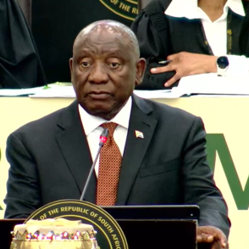
President Cyril Ramaphosa says government will intensify efforts to combat corruption, address illegal immigration, tackle the water crisis and turn around struggling municipalities as part of a broader drive to build a capable and developmental State.
Addressing Parliament during the Presidency Budget Vote on Tuesday, President Ramaphosa said strengthening law enforcement institutions and restoring public confidence in government remain key priorities.
“We continue to rebuild and strengthen our law enforcement agencies, security services, National Prosecuting Authority and specialised anti-corruption bodies,” he said.
The President said government was awaiting the final report of the Commission of Inquiry into Criminality, Political Interference and Corruption in the Criminal Justice System, chaired by Judge Mbuyiseli Madlanga.
He said the commission's recommendations were expected to strengthen the South African Police Service (SAPS) and broader efforts to combat corruption and organised crime.
According to President Ramaphosa, a special task team established by SAPS and the National Prosecuting Authority following the commission's first interim report had already begun bringing cases before the courts.
The President reiterated government's commitment to rooting out corruption.
“We must be unequivocal: public office is a public trust. Those who abuse public resources for private gain betray the Constitution, undermine development and steal from the poor.
“There will be no tolerance for corruption, regardless of position, status or political affiliation,” he said.
President Ramaphosa reported significant progress in implementing recommendations of the State Capture Commission.
“Of the 60 actions contained in our implementation plan, 80% are complete, substantially complete or on track,” the President said.
He added that recoveries linked to state capture investigations now exceeded R17 billion.
“The recoveries by law enforcement linked to the work of the Commission now stand at over R17 billion,” he said.
The President said ten new laws had been enacted to address weaknesses exposed by State Capture, including legislation aimed at improving procurement systems, professionalising the public service and reforming intelligence services.
Government had also approved a draft amendment to the Protected Disclosures Act for public comment.
“This Bill aims to strengthen the protection of whistleblowers and is a vital pillar of our fight against corruption,” the President said.
GBVF
He also highlighted government's efforts to combat gender-based violence and femicide (GBVF), which he said had been classified as a national disaster in November last year.
“In November last year, gender-based violence and femicide was classified as a national disaster, and Cabinet has approved an action plan to tackle this crisis and commit the necessary resources,” he said.
The President said prevention remains a priority, with increased focus on promoting positive masculinity among boys and young men.
Migration
On migration, the President acknowledged growing public concerns about illegal immigration and its impact on public services and employment opportunities.
“As announced in SONA [State of the Nation Address], government is taking decisive action to address this challenge. We are cracking down on violations of immigration laws.”
The President said government was increasing workplace inspections, prosecuting employers who break labour laws, strengthening border security and addressing corruption within the immigration system.
At the same time, he warned against xenophobia and vigilantism.
“We must never give in to violence, xenophobia or vigilantism. We will strengthen and enforce our laws, while upholding the Constitution and the human dignity of all,” the President emphasised.
Resolving the water crisis
A major focus of government's programme for the coming year will be resolving South Africa's worsening water crisis.
President Ramaphosa told Parliament that government had established a National Water Crisis Committee to coordinate implementation of the National Water Action Plan.
“Drawing on our experience in ending load shedding, we have established the National Water Crisis Committee,” he said.
The committee will oversee both emergency interventions and long-term reforms aimed at improving water management and service delivery.
“In the short term, national government will intervene directly in municipalities facing acute water failures using existing constitutional and legislative powers,” he said.
Fixing local government
The President said municipalities would also be required to ring-fence water revenue to ensure funds generated from water services were reinvested into infrastructure maintenance and upgrades.
He stressed that fixing local government was among the administration's most urgent priorities.
“The true test of government is not what happens at the Union Buildings or in the Houses of Parliament. The true test is whether water flows from a tap, whether a streetlight works, whether refuse is collected, whether a road is maintained and whether a community feels safe.”
President Ramaphosa said poor municipal performance was undermining economic growth and discouraging investment.
“If the conditions for investment in our cities and towns are unfavourable, if there is a lack of electricity or water or poorly managed infrastructure, investors simply take their business elsewhere,” he said.
To address these challenges, government is continuing to support reforms contained in the revised White Paper on Local Government and has expanded collaborative working groups in major metropolitan municipalities, including eThekwini and Johannesburg.
The President also announced plans to expand youth employment programmes, including the National Youth Service, which will provide 100 000 community service opportunities during the current financial year.
As government implements its reform agenda, President Ramaphosa called on all South Africans to participate in the next phase of the National Dialogue process, with pilot engagements scheduled to take place between June and August.
“I call on all South Africans to come together once more and be part of crafting a new vision for South Africa,” he said.
He concluded by saying government must remain focused on improving service delivery, creating jobs, combating corruption and strengthening democratic institutions.
“Work must now continue in earnest. Let us not allow ourselves to be deterred by distractions or political intrigue,” the President said. – SAnews.gov.za


