


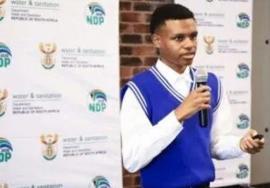
Mpumalanga has achieved a historic first after a Grade 11 learner from Sintintile Secondary School was crowned the 2026 national winner of the South African Youth Water Prize (SAYWP).
This secures Sinenhlanhla Sikhulile Nkosi’s position to represent South Africa on the global stage in Sweden later this year.
The 17-year-old from Kanyamazane in Mbombela, was named the overall winner during the 27th SAYWP national finals held in Kempton Park, Johannesburg, on Friday, 29 May 2026.
His victory marks the first time that a learner from Mpumalanga has won the national title, placing the province firmly on the map for youth-driven innovation in science, technology and water sustainability.
Hosted annually by the Department of Water and Sanitation (DWS), the South African Youth Water Prize is a flagship educational programme for learners in Grades 9 to 11.
The competition challenges young people to identify water-related problems in their schools and communities, conduct research, and develop innovative solutions that contribute to environmental protection and water security.
Sinenhlanhla captured the judges’ attention with his pioneering project titled “The Sentinel Barrier”, an engineered silicone-based elastomeric coating applied to the inner surface of polyethylene terephthalate (PET) plastic bottles.
The innovation is designed to prevent the release of microplastics and chemical leaching into drinking water, offering a practical response to one of the world's growing environmental and public health concerns.
As the national winner, Sinenhlanhla will represent South Africa at the Stockholm Junior Water Prize in Sweden in August 2026, where he will compete against some of the world's most promising young scientists from more than 30 countries.
Reflecting on his achievement, Nkosi said the victory was both humbling and inspiring.
“Winning still feels unreal. More than a personal achievement, I am excited about the opportunity to share my invention with the world. Stockholm is where leading water experts come together, and taking my solution from Kanyamazane in Mpumalanga to that global platform means a great deal to me.
“It demonstrates that innovation does not always require extensive resources or large institutions. Sometimes all it takes is identifying a problem and having the determination to address it,” Sinenhlanhla said.
Beyond the award, Sinenhlanhla sees the competition as a stepping stone toward a future career in engineering. He plans to pursue Mechanical Engineering after completing matric, believing it will provide the technical foundation needed to further develop his invention and contribute to solutions that improve water quality.
“My invention addresses a materials-based challenge, and Mechanical Engineering will equip me with the technical knowledge to improve it and develop scalable solutions.
“Mechanical engineers play an important role in designing systems that improve water treatment and protect water quality. I want to contribute meaningfully to solving the growing challenge of microplastic contamination through my future work,” he said.
Sinenhlanhla encouraged fellow learners to continue pursuing innovation regardless of competition outcomes.
“Not winning a competition does not define the quality of an idea. Every project contributes to learning, improvement, and helping to strengthen future work,” he said.
He advised learners to focus on their own growth and development, rather than comparing themselves to others.
The national competition showcased innovative research and inventions from learners across the country. Second place was awarded to Alissa Pillay from Star College Durban in KwaZulu-Natal, while third place went to Moegamat Panker and Rylee Joseph from Kimberley Technical High School in the Northern Cape.
Department officials congratulated Sinenhlanhla on his remarkable achievement and praised the role of teachers, mentors, and schools in nurturing young talent and innovation.
The Department further reiterated its commitment to strengthening collaboration with the Department of Basic Education to enhance water education and broaden opportunities for meaningful youth participation in the water sector.
DWS Gauteng Provincial Head Justice Maluleke encouraged learners to appreciate the important work being undertaken in the water sector and to make the most of the opportunities presented through the competition.
“I urge you to sharpen your minds while you are still in school and to fully embrace the learning experiences and engagement opportunities presented through the competition,” Maluleke said.
The adjudication panel comprised representatives from the Department of Water and Sanitation, the Water Research Commission, Nelson Mandela University, Rand Water and Thungela Resources. Seven adjudicators evaluated projects submitted under two categories: the Awareness Category, which focuses on identifying water challenges and proposing practical solutions, and the Innovation Category, which centres on developing technical models and inventions to address water-related issues.
All national finalists received bursaries and laptops in recognition of their commitment, innovation and outstanding participation.
One of the adjudicators, Mashila Phihlela, a former South African Youth Water Prize participant who now works for the Department of Water and Sanitation, shared an inspiring message with the finalists.
“I am somewhere in the future, and I look much better than I am looking now,” he said, encouraging learners to remain hopeful, ambitious and confident about their future. – SAnews.gov.za


