


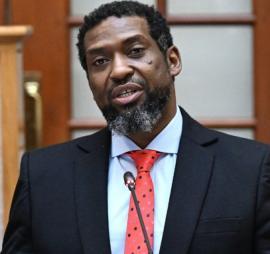
Minister of Higher Education and Training Buti Manamela says his department has moved to stabilise governance, reposition technical colleges and accelerate digital transformation since his appointment to office.
Delivering Budget Vote 17 in Parliament on Tuesday, Manamela outlined a series of interventions already implemented across the post-school education and training sector, saying his focus had been on identifying “where the system is stuck” and how to address longstanding weaknesses.
“Since my appointment, I have asked of every official, every entity, every council, and every meeting one question: where is the system stuck, and what will it take to unstick it?” Manamela said.
The Minister highlighted four key streams of work prioritised by the department since he took office.
The first stream included stabilising governance across institutions and entities under the department.
He said decisive action has been taken at the National Student Financial Aid Scheme (NSFAS) following governance and operational concerns.
“Where the institution fell short of the public trust placed in it, we acted within the law to restore order, protect students, and put in place a remedial path,” the Minister said.
The Minister also confirmed that underperforming Sector Education and Training Authorities (SETAs) have been placed under administration, while audit action plans, council development programmes and pre-employment screening for senior managers are being institutionalised across the sector.
“Consequence management is no longer a slogan; it is becoming a discipline,” he said.
The second focus area included the repositioning of Technical and Vocational Education and Training (TVET) colleges as the core driver of occupational and technical skills development.
Manamela announced that 24 new occupational qualifications have been introduced at TVET colleges from January 2026, and government has also set a target of 30% of TVET enrolment in occupational qualifications and skills programmes.
In addition, 500 TVET lecturers are expected to obtain formal qualifications, while 150 TVET council members will undergo training.
“We are establishing five regional industrial skills compacts, and by 30 September 2026, we will table a TVET Turnaround Strategy that confronts the system’s chronic challenges head-on,” the Minister said.
Thirdly, the department has started to build digital and future-skills capacity across the post-school system.
This includes plans to complete a feasibility study for online public TVET by March 2027, introduce a TVET digital transformation strategy, launch four new programmes on the National Open Learning System, integrate Khetha career services to reach 250 000 users, and establish a Skills Development Zone.
The fourth area of intervention has focused on reshaping the size and structure of the post-school education and training system.
Manamela said government is finalising a university enrolment plan for 2025 to 2030 and developing a five-year TVET enrolment strategy.
“We are addressing student housing and infrastructure as the precondition for any meaningful expansion,” the Minister said.
He said the reforms are intended to strengthen the link between education, employability, and economic growth.
“We inherit a system of great achievement and deep contradiction. It has opened doors for millions. It has not yet built enough bridges to work, to innovation, and to economic participation,” he said.
He added that government’s broader objective is to ensure that the post-school education and training system becomes a platform for economic inclusion, productivity, and opportunity for young South Africans. – SAnews.gov.za


