


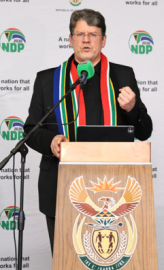
Justice and Constitutional Development Deputy Minister Andries Nel says the 30th anniversary of South Africa’s Constitution is a historic milestone that will continue to shape the country’s democracy and collective aspirations.
“The Constitution is more than a legal framework and more than just the supreme law of our country. It is the foundation of our democracy, rooted in human dignity, equality and freedom,” Nel said.
The Deputy Minister was speaking at the Milestones of Freedom Campaign panel discussion on Friday night.
Held at the Government Communication and Information System (GCIS) offices in Pretoria, the panel discussion came as the country marked the 30th anniversary of the Constitution's adoption on 08 May 1996, when the Constitutional Assembly formally adopted it.
“This year marks the 30th anniversary of that historic moment, a milestone that continues to shape our democracy and guide our collective aspirations,” said Nel, who, as a member of the Constitutional Assembly, helped draft the Constitution.
He also spoke of the Constitution's progressiveness, saying it enables South Africans to deliver the future they want.
“The Constitution is progressive because it not only recognises the injustices and inequalities of the past but places an obligation on government and citizens, women and men, young and old - to work to ‘heal the divisions of the past and establish a society based on democratic values, social justice and fundamental human rights,’” he said.
He told those attending the gathering that the commemoration is a national civic renewal campaign: a coordinated, multi-sectoral programme that reaffirms constitutionalism as the cornerstone of national identity.
This as Cabinet has adopted a programme providing for a year-long, whole-of-government and whole-of-society celebration of the Constitution.
Celebrating and reaffirming constitutional values, educating and engaging citizens, especially the youth, promoting the rule of law in everyday life, and fostering national unity and social cohesion are among the seven goals of the celebrations.
Nel spoke of the importance of this year’s national commemoration being an inclusive initiative by involving multiple stakeholders, including government departments, Chapter 9 institutions, civil society, academia, organised labour, business, traditional and religious leaders, youth formations, and educational institutions.
The programme will include public dialogues, civic education, cultural events, youth engagements, symbolic events at historic sites and other community driven initiatives to deepen constitutional awareness and social cohesion.
Milestones of Freedom
“The Milestones of Freedom Campaign is an important part of celebrating and commemorating this historic milestone. The campaign is a year-long, whole-of-government programme designed to honour our past while delivering tangible improvements in people’s lives today.
“Guided by the theme: 'Honouring the past, delivering the future’, this campaign brings together national, provincial, and local government, working hand in hand with communities and partners across society,” he explained.
The Deputy Minister said the panel discussion hosted by the GCIS in collaboration with the Department of Justice served as a precursor to the official launch later this month. He said it also provides an opportunity to engage deeply with the Constitution as a critical milestone of freedom - a living document that continues to safeguard our rights, strengthen accountability, and inspire our vision of a just, inclusive, and prosperous society.
This year, through the Milestones of Freedom Campaign, the government will also commemorate other defining chapters of the country’s history, including the 50th anniversary of the Soweto Uprising, 60 years since the District Six removals, and 70 years of the Women’s March, amongst others.
“These milestones remind us that our democracy was hard-won, and that its preservation requires active participation, vigilance and continuous commitment from all of government and all of society. Importantly, this campaign is not only about remembrance. It is about action.
“It is about bringing essential services to communities across the country - from IDs and birth certificates to health outreach events, access to housing opportunities, and support for small businesses and youth entrepreneurs, to name but a few,” Nel said.
In her message of support, the Deputy Minister in the Presidency for Women, Youth and Persons with Disabilities, Mmapaseka Steve Letsike, said the anniversary of the Constitution calls on South Africans not only to reflect on where they come from, but also to ask themselves how they are advancing the promise of dignity, equality and freedom for all.
“The Constitution itself laid the foundation for a society based on human dignity, equality and freedom, and it is through initiatives such as this campaign that we give practical meaning to these values.
“Let us therefore use this moment to strengthen our shared commitment to the values that unite us, and to ensure that the gains of our democracy are felt in every community across the country,” the Deputy Minister Letsike said.
Capable youth
In his message of support, Mthembeni Mzobe, President of the Student Chapter of the Black Lawyers Association, said that he appreciates the freedom the country has gained.
He added that many South Africans still experience freedom in part and not in full, stressing that the youth have a role to play in the country’s development.
“South Africa has a capable youth; our voices should not be treated as a threat to older leadership. Involve us, we are capable of bringing solutions to the challenges facing this country,” Mzobe said.
Inclusiveness
Meanwhile, Brand South Africa’s Chief Executive Officer, Neville Matjie, said the commemoration of 30 years of the Constitution is a defining milestone in the nation’s journey to freedom, democracy, and human dignity.
“At its core, our Constitution positions our country as inclusive, rights-based, [and] a society founded on human dignity, equality, freedom and social justice,” he said.
Charting the way forward
Speaking during the panel discussion, Chairperson of the Public Service Commission (PSC), Professor Somadoda Fikeni, congratulated the country on reaching the 30-year milestone of the Constitution.
“When we started our journey guided by this aspirational document, our Constitution, we did so well. In the early years, you could see houses where there were no houses, and schools where there were no schools.
“Institutions and the architecture of our democracy are still one of the best and aspirational,” he said in his reflection on developments in the country.
He said that to deal with challenges like corruption, “we have to go back to basics”, including fixing the public sector and fighting inequality.
“If we’ve become the most unequal society in the world, even the ability of a person to feel and exercise that democracy will elude that person. Democracy is not a noun, it’s a verb, it's what we do,” Fikeni said.
South Africa began the commemoration of 30 Years of the Constitution – a world-renowned document born from negotiation, compromise and public participation on an unprecedented scale in March 2026.
READ | From negotiation to nationhood: SA celebrates 30 Years of the Constitution
The Minister of Justice and Constitutional Development, Mmamoloko Kubayi, led the national launch held at the Apartheid Museum in Johannesburg. – SAnews.gov.za


