


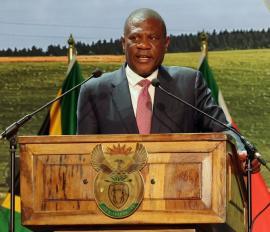
Deputy President Paul Mashatile has called for an end to the dualistic rural economy, where a few commercial farmers dominate output while millions of smallholder farmers remain excluded from sharing in the gains of the economy.
“We must link subsistence farmers to markets, foster partnerships, and build value chains that unite rather than divide so agriculture becomes a driver of shared prosperity,” the Deputy President said on Friday in Bloemfontein.
Mashatile was addressing rural development and land reform stakeholders at the National Rural Development Indaba, where he stressed that transforming and integrating the agricultural sector requires a shared responsibility approach.
He urged the sector to work together with the government in building rural communities that are safe, productive, connected, and fully integrated into the economy.
“At the heart of many rural economies lies agriculture. But we must be frank: subsistence farming alone cannot lift rural communities out of poverty.
“Our task is to build a productive, competitive, and transformed agricultural sector that creates jobs; supports agro-processing and rural industrialisation; integrates emerging farmers into value chains; and strengthens food security while growing the economy,” the Deputy President said.
This requires secure land tenure, post-settlement support, access to inputs and finance, and real market participation.
“It is within this context that the work of strategic coordinating departments such as the Department of Agriculture, the Department of Land Reform and Rural Development, the Department of Small Business Development, and the Department of Trade, Industry and Competition assumes strategic national importance.
“These departments, along with the various institutions and partners they collaborate with, remain essential in ensuring that the country capitalises on its competitive advantages and the growth opportunities it presents,” the Deputy President said.
He added that 30 years of the country’s development-based democracy have shown that South African cannot develop rural and urban economies separately.
“Our rural areas supply food, labour, energy, and natural resources. Our urban centres provide markets, technology, finance, and services. These are bound together in a single economic system.
“We must therefore abandon the false choice between rural and urban development and embrace integrated spatial planning, aligned infrastructure investment, and regional value-chain development.
“Sustainable rural development depends on strong, connected urban centres just as urban prosperity depends on strong rural producers,” the Deputy President said.
He mentioned that the Government's 30-Year Review emphasises that South Africa’s strategy should integrate agriculture, tourism, mining, natural resources, and forestry while being backed by strong economic infrastructure, including roads, water and sanitation, public facilities, and telecommunications.
“By prioritising the vibrancy of rural economies, the government aims not only to improve local livelihoods but also to curb the increasing migration pressures on urban centres,” Mashatile said.
The Deputy President made the point that the slow growth of rural economies leads to migration towards cities, as rural communities struggle with limited access to infrastructure, economic opportunities, and essential services, driving people to urban centers for better prospects.
“While urbanisation is a global trend, in our context it often reflects uneven development and limited economic prospects in rural regions. Addressing these spatial and economic imbalances requires a shift toward an integrated, multi-sectoral approach to development,” he said.
To address migration towards cities, Mashatile advocated for targeted, coordinated action by civil society, government, and private partners to rebalance urban and rural development.
Safety and security
The key to rural development is security, specifically rural safety and social cohesion, as development cannot take root where people live in fear, Mashatile said.
“Rural crime, stock theft, gender-based violence, and insecurity discourage investment and weaken the bonds of our communities.
“Safety must never be treated as an afterthought. It is an integral pillar of rural development. Without safety, there is no stability; without stability, there is no investment; and without investment, there is no renewal,” the Deputy President said.
Addressing rural safety requires a comprehensive strategy beyond policing.
“Key actions include strengthening rural policing through specialised units, empowering community safety structures (like neighbourhood watches and youth forums), and fostering collaboration among SAPS, traditional leaders, and local government.
“The strategy should also leverage technology for rural communication and surveillance while prioritising social cohesion programmes to combat gender-based violence and restore confidence in rural communities,” Mashatile said. -SAnews.gov.za


