


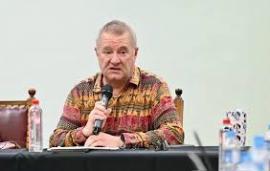
KwaZulu-Natal MEC for Finance Francois Rodgers has outlined a set of “non-negotiable” measures aimed at restoring financial discipline and accountability in municipalities across the province.
Tabling the third-quarter municipal performance report on Thursday, Rodgers warned that continued underperformance and governance failures would no longer be tolerated.
“Local government must stop managing crisis and start governing sustainably,” he told the provincial legislature.
Key non-negotiables outlined by the MEC include the adoption of credible, funded budgets and strict enforcement of credit control and debt management; full compliance with payment obligations to Eskom, water boards and suppliers; clean, accurate and timely reporting; and consequence management for persistent non-performance.
Rodgers emphasised that municipalities must improve revenue collection while maintaining accurate indigent registers to ensure support reaches qualifying households without undermining financial sustainability.
He also called for full compliance with payment obligations, particularly to bulk service providers such as Eskom and water boards.
“Failure to pay creditors within 30 days is a direct violation of the law and a threat to service delivery,” he said.
Accurate and timely financial reporting was highlighted as another critical requirement, with Rodgers warning that unreliable data undermines governance and decision-making.
“A municipality that cannot report accurately cannot govern responsibly,” he said.
The MEC further stressed the importance of consequence management, calling for disciplinary and criminal action against officials responsible for financial misconduct.
Citing recommendations from the Auditor-General of South Africa, Rodgers said the lack of consequences remains a major obstacle to improving municipal audit outcomes.
He urged municipalities to strengthen procurement processes, improve contract management, and eliminate irregular expenditure driven by poor planning.
The MEC also called for greater political oversight, including empowering Municipal Public Accounts Committees (MPACs); ensuring councils interrogate audit outcomes, financial health indicators and service delivery performance; and intervening early where dysfunction is evident, rather than waiting for Section 139 intervention.
“Without decisive political leadership, administrative improvements cannot be sustained,” he said.
Rodgers reiterated that provincial interventions are intended to support struggling municipalities but warned that accountability ultimately rests with local leadership.
“These interventions are not punitive. They are protective — aimed at restoring credibility, stabilising finances and safeguarding services,” Rodgers said.
He said the Provincial Treasury will continue to monitor performance closely and escalate interventions where necessary, as part of efforts to stabilise local government finances in KwaZulu-Natal.
“As Provincial Treasury, our role is to support, monitor and intervene. But responsibility ultimately lies where the Constitution places it — with municipal councils and accounting officers.
“The future of local government in this province will be determined not by Treasury alone — it will be determined by political will, administrative discipline, and ethical leadership at the municipal level,” the MEC said. – SAnews.gov.za


