


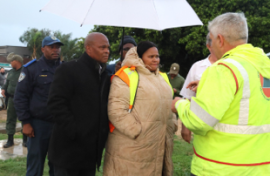
Nelson Mandela Bay Executive Mayor Babalwa Lobishe has been conducting site visits across flood-affected communities to ensure the smooth progress of relief interventions as heavy rains continue to disrupt large parts of the metro.
By Thursday afternoon, more than 1 000 residents had been evacuated from flooded areas, with the majority coming from low-lying informal settlements.
“The preliminary assessment indicates damage to critical infrastructure, including roads and electricity networks. We have also seen residents forced to leave their homes, significantly disrupting their normal lives,” Lobishe said.
The municipality, in collaboration with non-governmental organisations (NGOs) and churches, is providing displaced residents with essential support.
“Working with stakeholders, such as NGOs and churches, we will ensure that affected residents are provided with basic necessities while being accommodated in community halls,” Lobishe said.
Accompanied by municipal technicians, Lobishe also conducted an oversight visit to the Cuyler Bridge and the Swartkops River in Kariega to assess the structural condition of the bridges and monitoring rising water levels to ensure the safety and security of nearby communities.
Officials also evaluated potential risks that could necessitate further evacuations, particularly overnight, and discussed measures to mitigate further damage.
Lobishe said disaster management teams remain on high alert, operating around the clock to assist affected residents.
"As the rain continues and more areas remain flooded, we plead with residents to cooperate with disaster management officials on the ground so that we can limit injuries and avoid fatalities,” the mayor said.
Dams reach full capacity
Amid the widespread flooding, the municipality confirmed a significant turnaround in water security, with all major dams supplying Nelson Mandela Bay now at full capacity.
This includes Impofu Dam, the metro’s largest water source, with a capacity of approximately 107 000 megalitres, reached full capacity for the first time since 2016.
According to Lobishe, dam levels surged dramatically from 39% to 100% within just two days, following substantial rainfall in catchment areas, estimated at close to 100 000 megalitres.
The following dams are currently full:
• Impofu Dam – 107 000 megalitres.
• Kouga Dam – 128 000 megalitres.
• Churchill Dam – 35 300 megalitres.
• Groendal Dam – 13 700 megalitres.
• Loerie Dam – 18 800 megalitres.
Lobishe described the development as a major relief for both residents and the business community of Nelson Mandela Bay.
“[While this brings much-needed relief], this also poses a challenge for us as the city to ensure that we work on our infrastructure to preserve this water and stretch it as much as possible for us to survive the dry winter season,” Lobishe said.
She emphasised that improved water security not only enhances living conditions of residents but also boosts economic growth and investment attraction.
According to the Senior Director for Water and Sanitation, Barry Martin, the drought, despite occasional slight improvements, has been the longest in Nelson Mandela Bay’s history. – SAnews.gov.za


