


The impact of technology and rising uptake of social media are making an indelible mark on the landscape of journalism, shifting South African audiences from passive consumers to active participants in the news cycle.
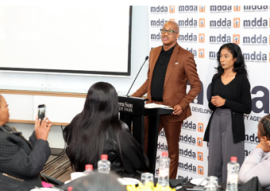
Deputy Minister in the Presidency Kenny Morolong on Wednesday said audiences are developing new “news habits” that are transforming the role of journalists and media institutions.
“The good deal of what we know about our world, we know because of journalism,” Morolong said.
Speaking at the Media Development and Diversity Agency (MDDA) Funders’ Breakfast in Hyde Park, Johannesburg, Morolong said technology, smarter phones and faster internet — coupled with the rise of multinational social media platforms — pull audiences away from local content and shrink revenue streams for news organisations.
“Audiences are also increasingly involved in both curating media for sharing and in commenting, or in other ways augmenting the media they share,” he said.
He warned that digital news consumption, particularly via mobile phones and social media, is fragmenting audiences, weakening traditional income sources.
Printed newspapers — from community titles to established publications — are closing or scaling down at a considerable pace, while community publishers are increasingly struggling to survive.
“While South African news organisations are developing some new business models and income streams that might sustain independent news journalism into the future, this is not happening fast enough or across enough platforms to forestall a likely decline in media diversity, despite the affordances of mobile Internet,” Morolong said.
In the midst of these challenges, Morolong acknowledged the role of funders and partners in keeping community media alive.
“… [Let me extend] government's deep appreciation for the vital role you play in building a vibrant and sustainable community media landscape.
“Today, we recognise your unwavering commitment and acknowledge the critical role that you, our funders and partners, have made in advancing media development and diversity in our nation.”
He emphasised that while the MDDA often measures its success through the number of community stations supported, the voices amplified and the reach achieved, the true foundation of that impact is anchored in partnerships.
“Behind every one of those measures lies a simple truth — none of it would be possible without partnerships,” he said.
The MDDA is a South African statutory body established in 2003 (Act No. 14 of 2002) to promote media development and diversity. It provides grant funding, training and research support to community and small commercial media, fostering a vibrant, innovative, sustainable, and people-centered sector, particularly in historically disadvantaged communities.
Changing times
Morolong highlighted the financial strain facing the community media csector, noting that the MDDA relies on limited public funds, which must be spread across many beneficiaries.
As a result, many community media outlets operate on tight margins, grappling with high operational costs that too often lead to unsustainability, particularly for smaller projects that struggle to meet regulatory requirements, such as audited financial statements.
Morolong said that 30% funding for community media is now government policy.
“These community radio stations, television broadcasters and print publications exist because of the ecosystem we have collectively built.
“They provide a platform for diverse perspectives, echoing the voices of the citizens they serve and facilitating the fundamental right to freedom of expression.”
He stressed that community media plays a direct role in strengthening democracy by improving access to information and contributing to better social and economic conditions.
With the first community station licensed in February 1995, the sector has grown into a powerful platform reflecting South Africa’s diversity.
Today, stations broadcast in a range of indigenous languages, including Nama and Khilobedu, ensuring that stories are told in languages that resonate most with communities.
Together, they reach an estimated four million listeners across all nine provinces, acting as a vital bridge for both information and culture.
Morolong said the sector’s resilience is supported by key industry bodies such as the National Community Radio Forum, the National Association of Broadcasters and the South African Community Radio Organisation, which continue to guide its growth.
Opening the event, MDDA representative Qondile Khedama underscored the importance of collaboration, telling delegates that the agency’s progress is rooted in strong stakeholder relationships.
“Without interaction with you, the MDDA would not be where it is today. Our interaction with you shows that you are one of the critical stakeholders,” he said.
Khedama called for robust discussions and forward-looking plans to ensure the sustainability of community media, stressing its critical role in local development.
Also addressing the gathering, Sandile Nene, Acting Deputy Director-General for Content Processing and Dissemination at the Government Communication and Information System (GCIS), acknowledged stakeholder support and reiterated government’s financial commitment through the 30 percent grant.
Nene reminded delegates that South Africa operates within a three-tier broadcasting system and that the MDDA was established as a statutory body to promote media development and diversity.
The MDDA Funders' Breakfast brought together representatives from community radio stations, newspapers and government, creating a platform not only for reflection, but for charting a path forward. – SAnews.gov.za


