


Government has formally lifted FMD restrictions within the KwaZulu-Natal Disease Management Area (DMA), signalling a shift in strategy as vaccination efforts intensify nationwide.
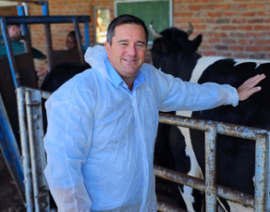
Agriculture Minister John Steenhuisen said the decision is not merely administrative, but that “it is rooted in a shift in the epidemiological story of the province”.
Since the first Disease Management Area was declared in 2021, the Minister said the country’s agricultural sector in the province has operated under a cloud of restriction, with movement controls designed to protect the national herd.
“As the situation has evolved, so too must our strategy,” Steenhuisen said at a media briefing on Tuesday.
However, the Minister stressed that lifting the DMA does not mean does not signal reduced vigilance, instead, it signals a move towards a "more modern, unified approach”.
“We are currently developing a countrywide movement control protocol for all cloven-hoofed animals to ensure that every province adheres to the same rigorous standards.
“By publishing this rescission in the Government Gazette, we will be allowing our KZN farmers to move forward under a single, clear set of rules that protects both their livelihoods and our national agricultural integrity,” the Minister said.
The move ends years of movement controls imposed since 2021, which had placed a significant economic burden on farmers in affected areas.
Government ramps up investment to secure national herd
Meanwhile, more than 2.5 million animals have been vaccinated across South Africa since the start of the country’s large-scale acquisition of vaccines in April 2026.
KwaZulu-Natal and the Free State had received the largest share due to higher livestock concentrations.
A total of 766 508 animals have been vaccinated in KwaZulu-Natal, followed by 446 527 in the Free State. In the Eastern Cape, 376 122 animals have been vaccinated; 233 510 in Mpumalanga; 188 073 in the North West; 184 036 in Gauteng; 183 770 in Limpopo; 164 474 in the Western Cape, and 46 996 animals in the Northern Cape.
“With our first batches of vaccine procurement from Biogénesis Bagó and Dollvet, we have already invested R238.2 million in this war. As we move into the next critical phase, our projected expenditure on vaccines - from our two international suppliers - will increase to over R644.5 million.
“This excludes the R72 million spent last year on BVI [Botswana Vaccine Institute] vaccines from Botswana for 900 000 doses – of which the MPO [Milk Producers Organisation] bought 50 000 doses, the RMIS [Red Meat Industry Services] 600 000 doses, and the Limpopo, the Free State and Mpumalanga took the initiative to buy and use their own vaccine stocks to protect their local farmers,” the Minister said.
The Agricultural Research Council has resumed limited vaccine production for the first time since the mid-2000s, releasing initial doses earlier this year and scaling up efforts to produce multi-strain vaccines suited to current outbreak conditions.
A new production fermenter is expected to boost capacity tenfold, significantly strengthening domestic supply over time.
Steenhuisen said the combined approach of international procurement and local production is critical to ensuring long-term resilience. - SAnews.gov.za


