


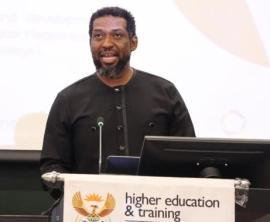
Higher Education and Training Minister Buti Manamela has called for the urgent development of a coherent education-to-work pipeline, stressing that South Africa must align early childhood development, schooling and post-school training to ensure young people transition successfully into the economy.
Delivering a keynote address at the National Education Summit held this week at the Gordon Institute of Business Science (GIBS) in Gauteng, Manamela said the country’s greatest challenge is not only unemployment, but a “crisis of pathways” that leaves millions of young people disconnected from opportunity.
The Minister warned that about 3.4 million young South Africans are currently not in employment, education or training (NEET), describing this as a “lived reality” reflecting systemic failures in linking education to economic participation.
“Our crisis is not only unemployment [but] a crisis of pathways. A system that does not yet move young people efficiently from learning into earning, from potential into productivity… from aspiration into dignity.
“We must build a pipeline that is coherent from early childhood, through schooling, into post-school education and training, and ultimately into the economy,” the Minister said.
Manamela said education should not be viewed as a merely sector, but a bridge between that waiting and economic citizenship.
The Minister identified Early Childhood Development (ECD), entrepreneurship education and vocational training as critical pressure points requiring urgent intervention.
He highlighted that government has made progress in ECDs through increased funding and expanded access, including the allocation of R18.4 billion over the medium term and the addition of 300 000 children gaining access to early learning programmes.
However, Manamela warned that only 42% of children are developmentally on track by the age of five, according to the Thrive by Five Index findings.
“This means inequality is not simply reproduced later in life. It is produced early, in access to nutrition, stimulation, language development, and quality early learning,” he said.
Turning to entrepreneurship, Manamela said the education system must evolve from producing job-seekers to job creators, particularly in an economy that cannot absorb all graduates.
He noted that all 50 public Technical and Vocational Education and Training (TVET) colleges are now offering entrepreneurship programmes, with more than 47 000 students participating in 2024.
He, however, stressed that success depends on providing practical exposure, access to funding and markets, and building confidence through mentorship and support networks.
“Entrepreneurship will not thrive in an economy that is structurally closed. This is not only about changing the mindset of young people but also opening the economy itself [and] ensuring that small enterprises can access funding, compete, and grow,” the Minister said.
Expanding centres of specialisation
On vocational education, the Minister highlighted a persistent skills gap, noting that while the economy requires approximately 30 000 artisans annually, the country is currently producing around 20 000.
He said government is expanding Centres of Specialisation, which are central to the country’s artisan strategy, increasing training capacity, improving quality, and aligning programmes with economic demand.
Targets include 37 000 artisan registrations this year, 29 000 artisans qualifying annually within the next two years, and over 200 000 work-based learning opportunities.
“Vocational education is not a second choice. It is a central pillar of our development. From fragmentation to a single system,” he said.
Manamela acknowledged that while significant funding has been allocated to education, including support for over 700 000 students through National Student Financial Aid Scheme (NSFAS) and daily meals for nearly 10 million learners, delivery, and execution matters.
“Our challenge is not a lack of programmes but fragmentation,” he said. “This is a system problem, and it requires a system response.”
He called for stronger collaboration between government, industry, labour, and civil society to build an integrated and responsive education system.
“When funding is delayed, when systems fail, [and] when young people are left uncertain, we are not simply dealing with administrative issues [but] breaking a contract. That is why we are addressing these challenges directly, with urgency and accountability.
“We have the plans, resources, and targets. Delivery requires all of us as government, industry, labour, and civil society to work together as a coordinated system,” Manamela said. – SAnews.gov.za


