


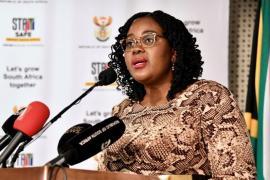
Justice and Constitutional Development Minister Mmamoloko Kubayi has emphasised that South Africa will continue to pursue gender parity on the judicial bench “vigorously and unapologetically”.
The Minister addressed the third day of the Second High-Level Meeting of Women Judicial Leaders of Africa held in Johannesburg this week, in conjunction with the Conference of Constitutional Jurisdictions of Africa (CCJA).
The gathering convenes women in judicial leadership across Africa, with the aim of fostering collaboration, facilitating the sharing expertise, and advancing constitutional justice and gender equality.
“Our country has made huge strides in empowering and affirming women jurists in the judiciary. At the advent of our democracy in 1994, our Judiciary comprised of 165 Judges of which 160 were white males, three black men and two white women. South Africa had no black woman Judge in 1994.
“Today, there are about 255 Judges in all the Superior Courts of which 131 are men and 124 women Judges.
“Progress has indeed been made however, more still needs to be done to ensure gender parity which we are vigorously and unapologetically pursuing,” Kubayi said.
She added that out of South Africa’s 15 Superior Courts, at least six are led by women, including the Constitutional Court as led by Chief Justice Mandisa Maya.
Additionally, the Constitutional Court has a majority of women Judges as well as the Supreme Court of Appeal – the country’s second highest court in the land.
“The Magistracy has fared much better in terms of gender transformation in that of the 1626 magistrates, 898 are women. This means that 55% of the total number of magistrates are women.
“We are immensely proud that women in the Judiciary continue to lead in our quest to transform our jurisprudence on gender equality, reproductive rights and the protection of the vulnerable. Their presence in the Judiciary is in line with the vision of our constitutional order,” the minister said.
Confronting challenges
Although hopeful of the future ahead for women in the judiciary and in general, Kubayi did not mince her words on the challenges that still persist in the sector.
She cited slow implementation and the scourges of Gender Based Violence and Femicide (GBVF) as two of the key obstacles to overcome.
“In the past 30 years, we have learnt that the codification legislative or regulatory does not always translate into implementation. The achievement of gender equality requires a deliberate set of implementable actions that are conceptualised with a gender perspective. We all know that power concedes nothing without demand.
“As happens in many countries around the world, South African women continue to experience high levels of pernicious discrimination and violence.
“And despite the plethora of progressive rights-based legislation in our country, we cannot claim that we are closer to delivering on the aspirations embedded in the Convention on the Elimination of All Forms of Discrimination against Women, the Maputo protocol, the Constitution and the Sustainable Development Goals, to promote gender equality and empower women,” Kubayi said.
The Minister bemoaned the abuse of women across the globe and the devastating effects it has on families, the grotesque scar it leaves on communities and how it undermines the rule of law.
“It is for this reason that our President, Cyril Ramaphosa, has declared gender-based violence and femicide (GBVF) a national disaster. Accordingly, South Africa developed, as a response, the National Strategic Plan on GBVF, a multi-sectoral, rights-based framework that seeks to eliminate GBV through coordinated prevention, protection, accountability, and support services.
“In addition to this, Government has also put in place a number of strategies to strengthen gender focused jurisprudence in our quest to fight the scourge of gender-based violence and other discriminatory practices,” Kubayi stated.
These strategies include:
- Expansion of Specialised Sexual Offences Courts and Thuthuzela Care Centres which designed are specifically to deal with GBVF;
- Strengthening of legal protections through the GBVF Legislative reforms;
- An online application service of domestic violence protection orders and the delivery of such protection orders through social media, e.g. WhatsApp;
- Judicial and prosecutorial training on gender sensitivity and victim empowerment;
- Development of a Femicide Watch to collect data and monitor GBVF incidents and trends, and
- Engagement with traditional leaders and community forums to embed constitutional values in every corner of society – ensuring that custom and culture do not undermine women’s dignity and safety.
From history to history making
Kubayi reminded the delegates that their presence in Johannesburg is a fulfilment of a legacy sparked decades ago.
Reflecting on the August 1956 Women’s March, she noted that the gathering coincides with the 60th anniversary of that historic defiance.
On that iconic day, struggle heroes Lilian Ngoyi, Helen Joseph, Sophie De Bruyn and Rahima Moosa led 20 000 women to the seat of the Apartheid Government in Pretoria, demanding the scrapping of pass laws.
“Asserting themselves through a firm slogan that says: ‘wathint’ abafazi wathint’ imbokodo, you strike a woman you strike a rock’, these brave women stood firm to tell their oppressors and the world at large that they too were their own liberators.
“Not only were they fighting for the end of racial and class discrimination, but they also fought for the unconditional end of gender discrimination,” Kubayi said.
Invoking the spirit of those 1956 heroes, the Minister emphasised that today’s judicial leaders must carry that same defiance to push back against discriminatory challenges.
“Many of you have personal stories about the obstacles that you had overcome and the walls you had to break down for you to get to where you are today.
“As women judges, your lived experiences provide better insight into the realities behind the cases. The resilience and courage of the delegates attending the conference is not only personal, but it is structural. It reshapes how law is interpreted, how justice is delivered, and how society evolves.
“This meeting should not only be used to exchange insights, but to sharpen our collective commitment to law that heals, courts that transform, and systems that centre around humanity. Together we can create a world in which men and women are equal,” Kubayi concluded. – SAnews.gov.za


