


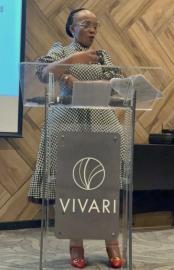
Minister in the Presidency for Women, Youth and Persons with Disabilities, Sindisiwe Chikunga, has called for stronger, more accountable public leadership to drive gender equality, describing it as “a matter of life and death”, rather than a policy formality.
Speaking at the Public Leadership for Gender Equality (PL4GE) in South Africa dialogue, held at Riviera Lane in Krugersdorp, Johannesburg, on Tuesday, Chikunga emphasised that the gap between government commitments and real impact on women’s lives remains a critical challenge.
“Public leadership determines whether policies remain words on paper or become real change in people’s lives. It shapes how budgets are allocated, how services are delivered, and how accountability is enforced,” Chikunga said.
Hosted by the Global Center for Gender Equality and supported by the Gates Foundation, the dialogue marked the start of an engagement focused on advancing inclusive leadership and gender equality. It highlighted the need to strengthen public leadership for gender-responsive governance, and to accelerate efforts to end gender-based violence and femicide (GBVF).
Chikunga said leadership must move beyond rhetoric, highlighting the importance of integrating gender considerations into everyday decision-making processes, such as budgeting, infrastructure planning and service delivery.
She said leadership courage looks like a Director-General, who insists that every budget submission in their department is accompanied by a gender impact assessment.
“Leadership courage looks like a provincial head of department, who refuses to sign off on an infrastructure programme that has not considered the safety and accessibility needs of women and girls with disabilities.
“It looks like a municipal manager, who ensures that community consultations do not only happen in boardrooms during working hours but in spaces and at times where the women, who are most affected, can actually participate,” the Minister said.
The Minister also noted alarming findings from the South African National Gender-Based Violence Prevalence Study, conducted by the Human Sciences Research Council (HSRC), which revealed that more than a third of South African women have experienced physical violence in their lifetime, underlining the urgency of decisive leadership.
She also emphasised the need for intersectional approaches, noting that women with disabilities face significantly higher rates of violence.
Chikunga said programmes, such as the Public Leadership for Gender Equality initiative, are critical in transforming institutions and redistributing power more equitably within the public sector.
“Gender equality is not optional for public institutions. It is part of the core business of the State,” she said.
The workshop forms part of broader government efforts aligned with the National Strategic Plan (NSP) on Gender-Based Violence and Femicide, which identifies gender-based violence as a national crisis.
Chikunga urged participants to translate lessons from the workshop into tangible actions within their departments.
“The test is not what happens in this room, [but] what happens when you return to your desks,” she said. – SAnews.gov.za


