


By William Baloyi
“Sustainable development is the pathway to the future we want for all.” As former United Nations Secretary-General Ban Ki-moon reminds us, this is not merely an aspiration, it is an urgent call to action.
It challenges governments to act with urgency and purpose to grow the economy, advance social justice, protect the environment, and strengthen governance - all at the same time. At the centre of this effort lies the need to unlock the full potential of Micro, Small and Medium Enterprises (MSMEs) through coherent policy, efficient local governance, and targeted economic reform.
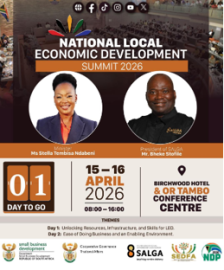
Against this backdrop, Government will host the National Local Economic Development (LED) Summit from 15 to 16 April 2026 at the Birchwood Hotel and OR Tambo Conference Centre under the theme, “Re-engineering Local Economies: A Collaborative Blueprint for Small Enterprise Growth and Ease of Doing Business.”
This Summit comes at a critical moment for our nation as aims to uplift our economy and the well-being of our society at large.
Local Economic Development is not just another policy discussion, it is a practical and proven mechanism to drive inclusive growth, create jobs, and improve the lives of people in our communities.
The LED Summit is designed as a high-level platform to unlock the economic potential within South Africa’s towns, cities, and rural areas. By strengthening public-private partnerships, it will promote LED as a place-based approach that is inclusive, innovative, and focused on building resilient local economies and more liveable communities.
Crucially, the Summit will bring together stakeholders from across society, government, business, MSMEs, cooperatives, and civil society with a clear purpose: to move from conversation to action. The priority must now be implementation that delivers measurable results and creates a practical, enabling environment for small businesses to thrive, driving growth, job creation, skills development, and municipal financial sustainability.
We cannot speak about LED without recognising the central role of MSMEs, which are the backbone of our economy. They play a vital role in tackling unemployment and inequality, opening opportunities for young people, advancing women’s economic participation, and sustaining local economies across the country.
Strengthening MSMEs is not optional; it is fundamental to building resilient communities and achieving inclusive growth.
To unlock the full potential of MSMEs, government is taking deliberate steps to remove barriers that constrain business growth. One key intervention is the Red Tape Reduction Framework, which provides municipalities and businesses with practical tools to eliminate unnecessary bureaucracy. By streamlining processes and improving efficiency, entrepreneurs can spend less time navigating compliance and more time growing their businesses.
This work is further supported by the rollout of the E-Registration System, aimed at simplifying and modernising business registration across districts and local governments. Making it easier to register a business helps bring more entrepreneurs—especially those in underserved communities into the formal economy, where they can access opportunities, support, and markets.
These initiatives are aligned with broader reforms outlined in the Revised Draft White Paper on Local Government. The proposed reforms focus on strengthening municipal governance, improving financial management, accelerating infrastructure delivery, and enhancing spatial planning. Effective governance remains the cornerstone of successful LED, and these reforms are geared towards building capable, responsive, and developmental local institutions that can drive economic growth.
The upcoming LED Summit presents a valuable opportunity to consolidate these efforts. It will galvanise coordinated action from government, business, and communities to strengthen partnerships and agree on practical steps forward. Importantly, it will ensure that policies translate into tangible outcomes particularly for informal traders and entrepreneurs who are the lifeblood of township and local economies.
Government continues to draw inspiration from the National Development Plan, which envisions an economy that creates jobs, reduces inequality, and eliminates poverty by 2030. Achieving this vision will require coordinated action, responsive governance, and sustained support for the entrepreneurs who drive economic activity at the local level.
This is not only an economic imperative it is a national mission. Government will play its part, partners must step forward, and together we must build an economy that works for all.
*Baloyi is the Deputy Government Spokesperson at the Government Communications and Information System.


