


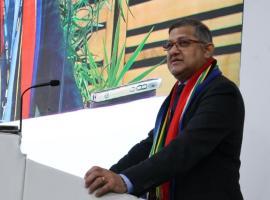
Deputy Minister of Forestry, Fisheries and the Environment, Narend Singh, has called for greater global fairness in the sharing of benefits derived from biodiversity.
The Deputy Minister made the call as he opened the third meeting of the Steering Committee on the multilateral mechanism for Digital Sequence Information (DSI) at the Kirstenbosch National Botanical Gardens on Tuesday.
Addressing delegates from across the world, Singh described the setting, located within the Cape Floristic Region, as a reminder of both the value of biodiversity and the shared responsibility to conserve it and ensure its benefits are distributed equitably.
He emphasised that the work of the Steering Committee comes at a critical time, noting that issues of fairness, equity and justice are central to how benefits from biodiversity are shared globally.
In Africa, biodiversity is closely tied to livelihoods, cultures and identities, the Deputy Minister said, adding that decisions taken during the meeting would have real implications for Indigenous people and local communities who have protected these resources for generations.
He pointed to South Africa’s advanced Access and Benefit-Sharing system, which is aligned with international agreements such as the Convention on Biological Diversity and the Nagoya Protocol, as an example of how equitable engagement between researchers, companies and communities can be achieved.
Singh said this made South Africa a fitting host for discussions on the multilateral mechanism and the Cali Fund.
Reflecting on progress made at the 2024 UN Biodiversity Conference (CBD COP16), Singh noted that countries had agreed to establish a multilateral mechanism to address the use of digital sequence information on genetic resources, including the creation of the Cali Fund.
He described the decision as a milestone aimed at ensuring that benefits arising from genetic data used in research and innovation are shared more fairly, while strengthening corporate responsibility.
He traced the development of the issue back to 2016, when digital sequence information first gained prominence under the Convention, and outlined how ongoing discussions, including global dialogues initiated by South Africa and Norway in 2019, helped build consensus.
He highlighted South Africa’s role in convening these engagements, including key meetings in Pretoria, which contributed to the eventual agreement reached in Cali.
Singh stressed that in the African context, benefit-sharing is not only a technical issue but also a historical one, noting that Indigenous knowledge has long contributed to sectors such as medicine and agriculture without adequate recognition or compensation.
He said the work of the Steering Committee and the development of the Cali Fund present an opportunity to address these imbalances and ensure that both monetary and non-monetary benefits reach the communities that have safeguarded biodiversity.
The Deputy Minister added that South Africa’s own experience demonstrates how the use of genetic resources can deliver tangible benefits for both communities and conservation efforts, and expressed hope that this experience could inform broader discussions on shaping a fair, inclusive and effective mechanism. – SAnews.gov.za


