


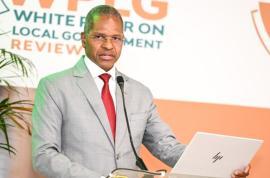
Cooperative Governance and Traditional Affairs Minister, Velenkosini Hlabisa, has called for urgent and coordinated action to reform South Africa’s local government system, stressing that municipalities must become stable, capable and reliable drivers of economic growth and service delivery.
Hlabisa made the call during the White Paper on Local Government Executive Dialogue with business leaders organised under the National Business Initiative in Centurion on Tuesday.
“South Africa requires a stable, capable and predictable local governance system that works consistently. Such a system cannot be rebuilt through short-term fixes. This is why the review adopts short-, medium- and long-term horizons, recognising that meaningful reform must be sequenced over time,” the Minister said.
The dialogue, hosted at Exxaro Resources, brought together senior government officials and business leaders to discuss the revised draft White Paper on Local Government and explore ways to strengthen municipalities.
The review process is guided by the theme: “Every Municipality Must Work: A Call to Collective Action”.
Hlabisa said government aims to ensure that municipalities function effectively for communities and businesses.
“Local government is the sphere closest to the people and the primary platform for economic growth and social development,” he said.
The Minister highlighted that the first White Paper on Local Government was adopted in 1998; and with this exercise, government is reimagining the next 30 years and charting a clear path for a modern, coherent, and resilient local government system.
“Today is about moving South Africa’s local government reforms from paper to practice, from discussion to disciplined execution, and from isolated fixes to a system that works in real places for households and firms, every day,” he said.
The Minister said government launched the review process last year and received 266 submissions from municipalities, business organisations, civil society, academia and traditional leaders.
These inputs helped shape the revised draft White Paper, which outlines a sequenced reform agenda aimed at modernising the country’s local government system over the next 30 years.
Hlabisa said the reforms come at a time when many municipalities are under severe pressure.
According to the latest consolidated municipal finance report by the Auditor-General of South Africa, only 41 of the country’s 257 municipalities achieved clean audits in the 2023/24 financial year, highlighting ongoing financial and governance challenges.
“These findings echo what communities and businesses experience: failing infrastructure, rising operating costs, and declining trust in the reliability of basic services,” Hlabisa said.
He outlined several key proposals contained in the draft White Paper, including treating local government as an integrated system rather than isolated institutions.
Among the proposals is the establishment of a national policy coordination centre to streamline regulations affecting municipalities and reduce duplication and conflicting requirements.
The White Paper also proposes a clearer framework outlining powers and functions across the three spheres of government to improve coordination and reduce disputes over responsibilities.
Hlabisa said the reforms will also introduce a data-driven oversight and early-warning system to identify risks in municipalities early and trigger support interventions before governance or financial crises occur.
He further emphasised the need for professionalisation within municipalities, including merit-based appointments and enforceable standards for senior officials.
The revised White Paper also proposes the development of a municipal digital governance system to integrate financial management, procurement, asset management and service delivery processes, improving transparency and accountability.
Hlabisa said collaboration between government and business would be critical to ensuring the success of the reforms.
“This dialogue is not another consultation tick-box. It is a working session at a critical juncture: the last structured opportunity for organised business to shape the final Draft White Paper before Cabinet consideration at the end of this month. We have the analysis. We have the architecture. What we need now is joint execution discipline,” he said.
He urged business leaders to provide practical proposals that could strengthen the implementation of reforms and help ensure municipalities become functional and investment ready.
The final draft of the White Paper on Local Government is expected to be submitted to Cabinet for consideration later this month. – SAnews.gov.za


