


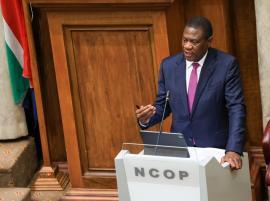
Deputy President Paul Mashatile says government has committed significant resources and reforms to restore South Africa’s rail transport system as part of efforts to strengthen economic infrastructure and stimulate growth.
Mashatile made the remarks on Thursday when responding to questions for oral reply in the National Council of Provinces in Cape Town. He addressed concerns about the decline and recovery of the national rail network.
He said government was implementing rapid response interventions to address service delivery challenges and disruptions in infrastructure hotspots.
“We have prioritised stronger intergovernmental coordination, improved planning and more effective execution across the spheres of government to restore the performance of critical economic infrastructure, including rail,” he said.
According to the Deputy President, government continues to engage several departments, including the Department of Public Works and Infrastructure, the Department of Transport, the Department of Water and Sanitation, and the Department of Cooperative Governance and Traditional Affairs to strengthen the upgrading and protection of strategic infrastructure that supports economic activity and job creation.
The Deputy President said Finance Minister Enoch Godongwana had allocated R21.9 billion through the budget facility for infrastructure to support major projects, including upgrades to Transnet’s coal and iron ore corridors to restore rail capacity.
Government is also strengthening the Passenger Rail Agency of South Africa (PRASA) to implement its corridor recovery programme and modernise rail services.
The Deputy President said by the end of 2025, PRASA had commissioned 35 of its 40 passenger corridors and achieved an audited annual figure of 77 million passenger journeys on long-distance rail services.
PRASA’s long-distance passenger division plans to reintroduce several mainline passenger services in the 2026/27 financial year, subject to funding availability and locomotive readiness.
These routes include Johannesburg–Durban, Johannesburg–Queenstown, East London–Johannesburg, Cape Town–Johannesburg, Johannesburg–Musina, and Cape Town–Queenstown.
Mashatile said PRASA was also rolling out thousands of kilometres of fibre optic infrastructure as part of a new signalling system through partnerships with the private sector to improve safety and real-time communication across the rail network.
Meanwhile, Transnet’s rail infrastructure manager, working with the Department of Transport and strategic partners, is prioritising the productive use of rail infrastructure and associated assets that have been underutilised, vandalised or inactive for extended periods.
“This work includes the revival of critical rail services that support agriculture, mining, manufacturing hubs and rural trading towns that rely heavily on rail connectivity,” Mashatile said.
Through Operation Vulindlela, government is also fast-tracking structural reforms aimed at modernising the rail and logistics sector, including opening the rail network to third-party operators to improve efficiency and competition.
He said the reforms would also accelerate the rehabilitation of passenger rail services to improve mobility, safety and economic participation for citizens.
The Deputy President said government plans to invest R500 billion in infrastructure over the next three years, with R120 billion ring-fenced for transport infrastructure, including rail rehabilitation, port efficiency upgrades and road network maintenance.
Responding to a supplementary question about the concessioning of rail lines, he said government had already begun implementing the National Rail Policy 2022.
He said the process has now moved into the implementation phase, including the design and operational rollout across rail corridors.
The Deputy President added that government is bringing the private sector on board, particularly companies involved in freight logistics.
“At the moment about 11 major freight companies have been enlisted, and work is continuing to finalise the contracts so that they can begin work on these corridors,” he said.
He expressed confidence that the combination of government investment, policy reforms and private sector participation would help reverse the decline of the rail system.
“I am confident that with the plans government has put in place, additional resources and private sector involvement, we will begin to correct this situation and ensure that rail infrastructure once again contributes to economic growth and job creation,” Mashatile said. – SAnews.gov.za


