


Thirty years after South Africa chose the rule of law over division and human rights over rule by exclusion, the country on Monday began the commemoration of 30 Years of the Constitution – a world-renowned document born from negotiation, compromise and public participation on an unprecedented scale.
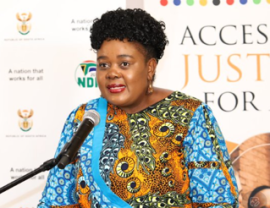
Minister of Justice and Constitutional Development, Mmamoloko Kubayi, on Monday led the national launch, which also marked the commencement of Human Rights Month at the Apartheid Museum in Johannesburg.
“Because of the adoption of the Constitution 30 years ago, we now have a foundation upon which we can strive towards the common vision of unity in diversity, whilst strengthening the culture of respect for human rights and the rule of law in South Africa,” Kubayi said.
Making of a miracle
The Constitution is a product of collective negotiations with a number of politicians, legal scholars, intellectual architects and negotiators participating in its formulation.
Often overlooked is the mass public participation that saw some 1.7 million submissions from individuals and civil society organisation – making it an inclusive body of legal work.
“The Constitution-making process was one of the most inclusive processes in modern times.
“The inclusivity of the process is best described by Justice Albi Sachs when he said the following about the Constitution: ‘We wanted a Constitution that was smiling to the people – but it mustn’t be a sneer smile, or an insincere mask of a smile. The smile must come from inside, that people may believe in it, because it’s authentic. And the smile contains tears, and sadness, and a knowledge of imperfection’.
“The Constitution is a testament that wise men and women of all races, religions and diverse cultures freely came together to weave a new nation in a South Africa that belongs to all who live in it, both black and white,” Kubayi said.
Decisive break with the past
The Minister noted that to truly appreciate the “magnitude of what the Constitution… represented, one must first reckon with what preceded it”.
“For over three centuries, colonialism and then apartheid did not merely discriminate -- it institutionalised and systematised human degradation, and in particular, of the black South African majority. Both colonial and apartheid regimes implanted racial hierarchy into the fabric of law itself, so that the very institutions that ought to have protected citizens became instruments of oppression. Justice was not blind; it was deliberately sighted, and it saw race.
“What the negotiated transition of the early 1990s accomplished, therefore, was not merely a political handover but a civilisational reorientation. The Interim Constitution of 1993 described the moment as a historic bridge, as it symbolised a passage from strife and injustice to peaceful coexistence premised on open democratic governance and the pursuit of universal human rights.
“That bridge led, in 1996, to the final Constitution, a document that did not simply list rights but rooted them as the supreme law of the land, binding the executive, the legislature, and the judiciary alike,” the Kubayi said.
When law outruns life
The Minister acknowledged that the years following the adoption of the Constitution have not been “seamless or without contradiction”.
“What the record of these 30 years also reveals, however, is that the communities that bore the heaviest cost of apartheid’s deliberate impoverishment have not experienced the pace of transformation that the Constitution’s provisions reasonably implied.
“Those who were systematically denied access to property, education, and the basic conditions of a dignified life have found that, while the legal order has been fundamentally recast, their material circumstances have not shifted with commensurate decisiveness,” she said.
The Minister cited “corruption, persistent resource constraints, and uneven implementation” as some of the core challenges that have “drawn the pace of delivery away from what the legal framework envisioned”.
“The consequence is a Constitutional democracy in which the law has advanced with considerably greater speed and clarity than the material reality it was expressly designed to transform, not because the framework is wanting, but because the administrative and financial conditions necessary to give it full effect have not been consistently sustained.
“This is the central tension that three decades of Constitutional democracy has not yet resolved. The framework has proven its durability in the courts, the legislature and in the institutions created to give it effect.
“What has not kept pace is the translation of that framework into the daily lives of those it was most urgently intended to serve. That remains the most consequential measure by which this Constitutional project will continue to be assessed,” Kubayi said.
A living document
Despite these challenges, the Minister emphasised that the Constitution itself was never designed to be a “static”, unresponsive document.
“From its inception, it was conceived as a living framework, one capable of responding to an ever-changing legal, social, and political context.
“As reflected by the Reconstruction and Development Programme's insistence on integrated, people-driven, sustainable development, the Constitution built into its very structure the expectation that the work of transformation would be ongoing, that rights would be progressively realised, and that the institutions of justice would continue to evolve in response to the demands placed upon them,” she explained.
Bastion of human rights
The Minister cited the “structural integration of the justice system” as one of the Constitution’s most consequential achievements.
Alongside that is the advancement of human rights that the document provides.
“[It] is here that the Constitution’s responsiveness is perhaps most vividly demonstrated. At the nub of the Constitutional dispensation lies the Bill of Rights. Chapter 2 does something ambitious that, thirty years on, still deserves appreciation, specifically in that it refuses to treat civil and political rights as somehow more real or more pressing than socio-economic rights.
“The right to equality, to human dignity, to privacy, and to freedom of expression are articulated alongside the rights to housing, healthcare, food, water and education. These rights are far beyond aspirational ornaments; they are justiciable entitlements, enforceable in courts of law. What makes their entrenchment particularly significant is that it does not freeze them in time,” Kubayi stated.
She added that the Constitution interpretive framework “obliges courts to develop the content of rights in a manner that responds to present-day circumstances and evolving understandings of human dignity”.
“Legislation giving effect to this vision has progressively extended the Constitution’s reach into the everyday encounters citizens have with government, addressing unfair discrimination, protecting access to information, and insisting on transparency, lawfulness, and reasonableness as conditions of legitimate administrative action.
“Our Constitution has set out the framework for our human rights realisation discourse and the Constitutional Court has been a pillar that has interpreted the core minimum of these provisions, as set out by the Bill of Rights,” she said.
The Constitution also makes provision for the hard-fought rights it protects to have independent guardians in the form of Chapter 9 institutions like, amongst others, the South African Human Rights Commission and the Commission for Gender Equality.
“Chapter 9 of the Constitution recognised, with considerable foresight and accordingly established a set of independent State institutions, whose specific mandate is to strengthen and sustain constitutional democracy.
“These institutions represent a deliberate constitutional choice to institutionalise oversight rather than leave the protection of rights to the discretion of those in power. They were built into the Constitution itself, rather than created by ordinary legislation, and this reflects a deliberate choice to implant oversight at the highest level of the legal order,” Kubayi noted.
National commemoration
The Minister revealed that the national commemoration of the birth of the Constitution will bring together all parts of society.
“Just like the Constitution-making process, the national commemoration we envisage, will be an inclusive initiative involving multiple stakeholders, including government departments, Chapter 9 institutions, civil society, organised labour, business, traditional and religious leaders, youth formations, and educational institutions, women and people with disabilities,” said the Minister.
Cabinet has approved a concept document that guides this yearlong celebration and an Inter-Ministerial Committee (IMC) chaired by the Department of Justice and Constitutional Development has been established to oversee this work.
“The programme will include public dialogues, civic education, cultural events, youth engagements, symbolic events at historic sites such as Sharpeville and Constitutional Hill, and other community driven initiatives to deepen Constitutional awareness and social cohesion,” she said.
South Africa will also host an International Conference on Access to Justice to reflect on the “journey travelled, and renewal our commitment to the principles of our Constitutional democracy”.
“We call on all South Africans to join us in these initiatives so that we can collectively reflect on the 30 years of our Constitution, progress and challenges, and recommit ourselves to the democratic project,” Kubayi said. – SAnew.gov.za


