


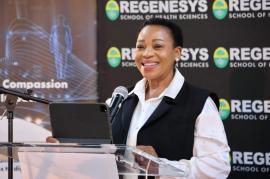
Higher Education and Training Deputy Minister, Nomusa Dube-Ncube, has called for a new generation of health science research that goes beyond diagnosing disease, to confronting and dismantling the systems that sustain illness and inequality.
Speaking at the launch of the Regenesys School of Health Sciences in Sandton, Johannesburg, Dube-Ncube emphasised that the future of health science must be intersectional, decolonised, context sensitive, and justice centred.
“We need research that goes beyond disease diagnosis, but one that dismantles the systems that perpetuate them. The future of health science cannot afford to be reductionist or narrow,” Dube-Ncube said.
Launched on Tuesday, the Regenesys School of Health Sciences aims to integrate artificial intelligence (AI) and innovation into healthcare education, preparing leaders to address system challenges. The initiative is designed to tackle health challenges by training professionals in modern, technology-focused healthcare, complementing existing nursing and curative practices.
Addressing academics, industry leaders and students, the Deputy Minister noted that the department’s presence at the event signalled its commitment to partnership in advancing the Post-School Education and Training (PSET) sector.
She acknowledged that private institutions often face scepticism rooted in the perception that “private means profit first before people”. However, she said the responsibility lies with institutions such as Regenesys to dispel the notion by following every regulation and guideline to the tee, as provided by the department.
“Your actions and diligence in following the rules will help inspire the youth that sit despondent at home and the students that have marked you as their institution of choice,” the Deputy Minister said, stressing that government’s willingness to work with private institutions would never compromise compliance standards.
The department’s vision for the future of education includes expanded blended learning models, improved access and a more futuristic, skills-based approach to education.
This, she said, is essential in a rapidly changing world, where technological shifts are reshaping industries and professions.
“For us who are in decision making positions, the posture we hold for the desire of the future must be aligned with what we think will be good for the future and most importantly, the youth of this country,” Dube-Ncube said.
South Africa’s medical doctors and research community were lauded globally during the COVID-19 pandemic, with local scientists and clinicians recognised among the best in the world.
“That is something that we should celebrate and ensure that it is increased and guarded jealously through the improvement of the education offered. We must always aim higher.”
She said the country carries the disproportionate burden of disease, communicable and non-communicable, compounded by poverty, malnutrition, unemployment, gender-based violence (GBV) and deep systemic inequality.
The Deputy Minister expressed hope that students emerging from the new medical school would bridge “the chasm between data and dignity, between publications and lived realities.”
Strengthening private-public partnership
Dube-Ncube also underscored the importance of public-private partnerships in tackling South Africa’s challenges. She said government is committed to strengthening linkages with industry to reduce graduate unemployment and to foster innovation.
“We need a multi-sectoral approach to solve South Africa’s crises -- be it in education or healthcare. It is imperative that the approach to this be honest and impassioned because the task that lies ahead of us, whether you are in government or in the private sector, is to think beyond the confines of your own industry and sector,” the Deputy Minister said.
Drawing on international experience, including engagements with education systems in China and Hungary, the Deputy Minister highlighted the transformative role of technology in improving access and quality while striving for equity. – SAnews.gov.za


