


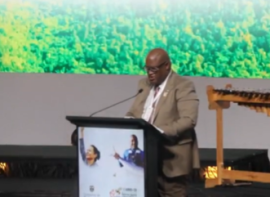
Land Reform and Rural Development Minister Mzwanele Nyhontso has acknowledged that while South Africa has recorded notable successes in land reform since 1994, progress has been slower than anticipated.
The Minister was addressing the second International Conference on Agrarian Reform and Rural Development (ICARRD+20), currently underway in Cartagena de Indias, Colombia.
Taking place from 24 to 28 February 2026, ICARRD+20 conference provides a strategic platform for governments, social movements, and international organisations to deliberate on pressing global challenges, including land and water grabbing, climate change vulnerabilities, and the need for redistributive land reform.
In his address, Nyhontso noted that democratic South Africa’s land reform programme has been anchored on three pillars, including restitution, redistribution and tenure reform.
“While the implementation of this approach has seen some significant successes where a few communities have reclaimed their ancestral land, or others among the landless have been assisted to obtain land on which they have attempted some developmental activities, progress has been slow,” Nyhontso said.
Outlining measures to accelerate transformation, Nyhontso said government is overhauling its redistribution programme, starting with the formulation of the Equitable Access to Land Bill. The legislation seeks to streamline procedures and prioritise the landless, particularly those with the potential to become successful commercial producers.
He reiterated that land redistribution must be pro-poor and state-led and must affirm the rights of women and youth to equitable access to land.
“We have a clear policy undertaking that 50 percent of all land that is redistributed must go to women and 40 percent to the youth, to ensure the future of the resilience of the rural economy,” the Minister said.
He noted an encouraging trend of young people, including young women, entering farming, and emerging as successful agrarian entrepreneurs. He added that government is strengthening support systems to ensure beneficiaries of land reform programmes are sustainable and productive.
Nyhontso asdmitted that South Africa’s earlier “willing-buyer, willing-seller” model, a market-led approach, did not achieve the desired pace or scale of transformation. As a result, government has introduced new measures, including the Expropriation Act, and is advancing additional legislation such as the Communal Land Tenure and Administration Bill.
“These are not merely legislative tools, but instruments of decolonisation.”
The Minister also highlighted ongoing challenges, including illegal evictions of farmworkers and labour tenants from commercial farms, underscoring the need to secure tenure rights for residents of communal areas.
Beyond national policy, the Minister called for strengthened global governance mechanisms. South Africa supports empowering FAO’s Global Land Observatory to monitor land governance and urged the Committee on World Food Security to report regularly on the implementation of international declarations protecting peasants and Indigenous peoples. – SAnews.gov.za


