


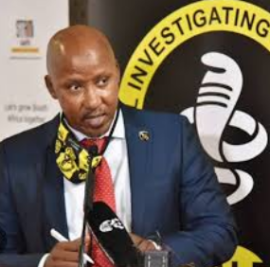
The Special Investigating Unit (SIU) has recommended that Home Affairs considers the vetting of all employees of the department as one of the range of measures to address vulnerabilities in the country’s immigration system.
The SIU on Monday briefed media on the outcomes of the Home Affairs investigation which was authorised by President Cyril Ramaphosa under Proclamation 154 of 2024. An interim report outlining the outcomes of the investigation has since been submitted to the President.
The investigation has revealed that South Africa’s immigration system has been treated as “a marketplace, where permits and visas were sold to the highest bidder”.
“Officials entrusted with safeguarding the integrity of the Department of Home Affairs instead turned their positions into profit-making schemes, while external actors, including religious figures and entertainment industry personalities, exploited influence, fabricated documentation, and manipulated systemic weaknesses to secure fraudulent residence permits,” said Acting Head of the SIU, Leonard Lekgetho.
WATCH |
Investigation background
Lekgetho said a whistleblower brought forward to the SIU allegations that foreign nationals enter South Africa, fraudulently obtain asylum seeker permits, and later use them to apply for permanent residence and ultimately citizenship.
“The SIU received information that these foreign nationals collude with syndicates involving corrupt Home Affairs officials to secure permits without merit, as permits are issued upon application without assessing the asylum claim.
“Holders can remain in the country, even if their application is rejected by exhausting appeal rights up to the Constitutional Court, regardless of the merits of their application.”
The SIU obtained a Special Tribunal order to investigate and, with the assistance of the Directorate for Priority Crime Investigation (the Hawks), they searched five Refugee Reception Offices, seizing laptops, desktops, cell phones, external drives, and files. Two hundred and thirty-seven items were imaged for cyber forensic analysis.
Cell phone analysis revealed communication between officials and foreign nationals, with payments via e-Wallet ranging from R500 to R3 000, facilitating the unlawful issuing of permits and visas to unqualified individuals, the SIU said.
“Payments were made through various methods: cash hidden in application forms, with office doors closed to avoid cameras; e-Wallet deposits using non-RICA registered or fraudulently RICA [Regulation of Interception of Communications and Provision of Communication-related Information Act] registered numbers; asylum seekers sending e-Wallet payments to themselves and providing OTPs to officials, and in-kind payments, such as covering officials’ private rent or services. Officials used dummy phones to conceal transactions and communication,” said Lekgetho.
The nefarious exchange: Citizenship for luxury lifestyles
The “nefarious syndicate" - as described by Lekgetho - is a coordinated group of department officials responsible for the lawful processing, adjudication and receipt of visa applications. However, the Acting Head said they instead engaged in behaviour suggesting systemic corruption and illicit enrichment, in violation of their official duties.
“The SIU can reveal that, so far, we have uncovered that four officials, who earn less than R25 000 per month, have received a total of R16 313 327.00 in direct deposits.
“Evidence indicates that certain members of this group have acquired significant assets that are grossly disproportionate to their legal income. This includes the cash purchase of multiple properties and the construction of high-value residential developments.
“Some members have developed private properties with extensive infrastructure, such as large-scale solar installations and spacious parking lots, suggesting access to capital inconsistent with their official salaries,” Lekgetho said.
The SIU’s investigation, said Lekgetho, shows that certain officials turned the permit system into a “marketplace”.
“Their modus operandi was simple: applications were sent via WhatsApp for expedited approval, and once approved, money flowed almost immediately. Payments were not made directly to officials but funnelled through accounts held by their spouses, deliberately disguising the bribes.
“In one case, a permit was approved on 20 December, and by 21 December, R3 000 had been deposited into the spouse’s account. Another transaction saw R6 000 transferred days after two permits were approved. These transactions reveal a direct link between approvals and payments, leaving no doubt that permits were being sold.”
Officials also reportedly operated within syndicates, using intermediaries to collect funds from foreign nationals. Transaction references such as “Permit”, “Visa Process”, or “Building Material” were used to mask the true nature of payments.
Secondary accounts belonging to spouses received unexplained cash deposits amounting to hundreds of thousands of rand.
The scale of enrichment, Lekgetho remarked, was staggering.
“Analysis of a construction company registered in the name of one official’s husband revealed deposits totalling R8.9 million between 2020 and 2023. These deposits were inconsistent with legitimate construction business activity and included payments explicitly referencing “PRP” (Permanent Residence Permit). At least R185 000 was directly linked to PRP applications.
“Officials turned their spouses into silent partners in crime.
Another official accumulated so much wealth that she built a mansion and a paved road leading to her home on a monthly salary of R25 000,” Lekgetho noted.
The SIU has also traced financial gains exceeding R181 million associated with beneficiaries of fraudulent visa applications, which were underpinned by fake documentation.
Investigation into identity fraud and DNA manipulation
Based on the findings of the SIU, in conjunction with Interpol, a significant scheme of identity fraud has been uncovered, primarily involving foreign nationals who obtain South African passports to commit crimes abroad or seek refugee status elsewhere.
The investigation revealed a specific modus operandi in which these individuals collude with departmental officials to gain unauthorised access to Home Affairs’ offices.
Once inside, they fraudulently use the fingerprints of unsuspecting South African citizens, while substituting the photograph on the application with that of the foreign national.
“In response to these findings, the SIU has proposed systematic recommendations to bolster security. We advise that, while the department is implementing its biometric system, it should enforce stricter controls on passport photographs.
“Furthermore, the SIU recommends strengthening physical access control to departmental offices to ensure that all individuals entering Home Affairs facilities can be positively identified, thereby preventing such internal collusion,” said Lekgetho.
In a parallel investigation, the SIU uncovered evidence of DNA sample swapping and manipulation, a scheme designed to favour foreign nationals in their applications for Permanent Residence Permits.
This practice exploits the requirement for DNA testing, conducted by the National Health Laboratories Services, which is a prerequisite for certain visa categories.
Lekgetho said the SIU has found prima facie evidence that these biological results are being tampered with to benefit foreign applicants.
“Although this specific manipulation may not fall strictly under the Department of Home Affairs’ direct operational control, the SIU has formally alerted the department to this observation to ensure inter-agency awareness and cooperation.”
He said another factor that compounds issues of fraud is the systemic abuse of the retirement visa category, which the SIU attributes to a lack of clear departmental guidelines for its adjudication. The investigation revealed that this regulatory gap directly leads to manipulation and fraud, particularly because the visa type has no age restriction, making it susceptible to widespread abuse.
“A core part of the problem lies in the fact that while applicants are required to prove a monthly income of approximately R37 000 to obtain the visa, the department failed to monitor compliance with this financial requirement after the permit has been issued.
“This lack of post-issuance oversight creates an environment, where the visa’s conditions can be easily circumvented, undermining the integrity of the immigration system.”
Recommendations to strengthen immigration system
To curb fraud and corruption in the immigration system, the SIU has recommended that:
- The Department of Home Affairs should strengthen its contract management. The Department should consider the enforcement of an ethical culture and provide ethical training to its employees.
- The department should consider vetting of all employees.
- The department should consider system integration on all its processes, including those of other government departments linked to the Department of Home Affairs.
- The system integration should take into account the interim findings of the SIU and the observations thereto.
- The department should consider developing a step-by-step guideline on how verification should be conducted.
- The department should consider strengthening its verification process before the issuance of visas.
- The department should consider having quality assurance before the issuance of visas. The department should consider system integration between the department and the Department of Labour.
- The department should consider enforcing compliance with its prescriptions by the company to issue a business visa to report to the department upon termination or cancellation of the visa.
“The findings make one thing clear: South Africa’s immigration system was treated as a commodity. Permits and visas were sold, traded and laundered. These findings show that corruption in the visa system is not incidental; it is organised, deliberate, and devastating to public trust. Integrity is betrayed,” Lekgetho concluded. – SAnews.gov.za


